
As per Intent Market Research, the Artificial Sperm Market was valued at USD 0.1 Billion in 2024-e and will surpass USD 0.6 Billion by 2030; growing at a CAGR of 37.2% during 2025 - 2030.
The artificial sperm market is gaining momentum due to increasing advancements in reproductive health technologies and a growing need for innovative solutions to address infertility issues. Artificial sperm technologies, including stem cell-derived sperm and synthetic sperm production, offer groundbreaking approaches to male infertility, providing potential solutions for individuals with no viable sperm. With global rates of infertility on the rise, coupled with the demand for fertility treatments and genetic research, the artificial sperm market is positioned for substantial growth. Ongoing developments in gene editing technologies further enhance the potential for creating viable, functional sperm that can assist in conception and reproductive health.
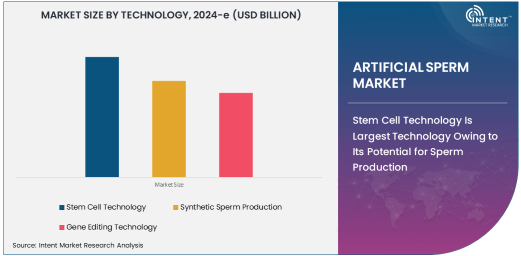
Stem Cell Technology Is Largest Technology Owing to Its Potential for Sperm Production
Stem cell technology is the largest technology segment in the artificial sperm market due to its vast potential in generating functional sperm. Researchers have made significant progress in using stem cells, particularly induced pluripotent stem cells (iPSCs), to create sperm cells that closely mimic natural sperm. This technology allows for the cultivation of sperm from stem cells in vitro, offering a solution for males with non-functioning or absent sperm production.
Stem cell technology has the added advantage of being able to overcome genetic barriers, enabling the potential for sperm production from individuals with genetic disorders that impair fertility. As research in this area continues to evolve, stem cell technology remains the cornerstone of artificial sperm development, with wide-ranging implications for both fertility treatment and genetic research. The progress in this field is expected to continue driving the dominance of stem cell-based technologies in the artificial sperm market.
Infertility Treatment Is Fastest Growing Application Owing to Increasing Demand for Fertility Solutions
Infertility treatment is the fastest-growing application in the artificial sperm market, driven by rising infertility rates and a growing need for assisted reproductive technologies (ART). As more couples and individuals seek alternative solutions to traditional fertility treatments, the demand for artificial sperm has increased significantly. Conditions such as azoospermia, a condition where a male is unable to produce viable sperm, create a market for artificial sperm technologies to provide new hope for conception.
The ability to generate sperm from stem cells or synthetic processes offers solutions for individuals who previously had limited options for having biological children. As awareness of these technologies expands and the efficacy of treatments improves, the artificial sperm market is expected to experience a sharp rise in adoption for infertility treatment purposes.
Fertility Clinics Are Largest End-Use Industry Due to High Demand for Assisted Reproduction
Fertility clinics represent the largest end-use industry in the artificial sperm market, driven by their primary role in offering reproductive health solutions and infertility treatments. These clinics serve as the primary centers where assisted reproductive technologies such as sperm donation, in vitro fertilization (IVF), and sperm retrieval techniques are applied. As artificial sperm becomes a viable alternative for patients with male infertility, fertility clinics are leading the adoption of these technologies.
Fertility clinics are increasingly offering a broader range of services, including those that integrate artificial sperm into their treatment regimens. The ability to provide patients with viable sperm alternatives enhances their service offerings, contributing to the growing importance of fertility clinics in the artificial sperm market. As demand for fertility services continues to rise globally, fertility clinics are expected to remain the central hub for the application of artificial sperm technologies.
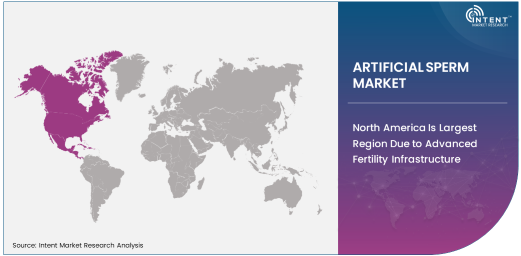
North America Is Largest Region Due to Advanced Fertility Infrastructure
North America is the largest region in the artificial sperm market, driven by its well-established fertility infrastructure, high awareness of infertility treatments, and advanced healthcare systems. The U.S., in particular, has numerous leading fertility clinics and research institutions focused on reproductive health, making it a key player in the artificial sperm market.
In addition, North America has a high number of medical laboratories and research institutes engaged in groundbreaking work on stem cell technology and synthetic sperm production. The availability of sophisticated healthcare services, strong regulatory support, and an extensive network of fertility specialists and clinics contribute to North America’s dominance in the market. As the region continues to innovate in reproductive medicine, it will maintain its leadership in the artificial sperm market.
Competitive Landscape and Key Players
The artificial sperm market is characterized by a combination of academic research institutes, medical laboratories, and innovative companies working on cutting-edge reproductive technologies. Key players in this market include companies focused on developing stem cell technologies and synthetic sperm solutions. Research institutes such as the University of Kyoto and the Chinese Academy of Sciences are at the forefront of advancing these technologies, particularly in stem cell-derived sperm production.
As the market matures, companies involved in gene editing technologies and reproductive health services are likely to increase competition, driving innovation and offering new solutions for infertility treatment. Partnerships between fertility clinics, research organizations, and biotechnology firms are expected to become more common, helping to accelerate the development and commercialization of artificial sperm technologies. This competitive landscape is expected to result in continuous advancements and greater availability of solutions for individuals seeking fertility treatment.
Recent Developments:
- OvaScience announced a breakthrough in synthetic sperm production using stem cell technology, offering new hope for male infertility treatments.
- Shenzhen BGI revealed its partnership with global research institutes to advance gene editing technology aimed at creating functional sperm for assisted reproduction.
- Irvine Scientific launched a new artificial sperm product for use in fertility clinics, enhancing success rates in male infertility treatments.
- Thermo Fisher Scientific expanded its biotechnology division to focus on synthetic reproduction technologies, including artificial sperm production.
- Merck Group secured a patent for a novel artificial sperm generation technique, offering a potential solution for male infertility on a global scale.
List of Leading Companies:
- OvaScience
- Shenzhen BGI
- Stemcell Technologies Inc.
- Irvine Scientific
- Thermo Fisher Scientific
- ReproTech
- Merck Group
- Genea Biomedx
- Fertility Institute of New Jersey
- Eppendorf AG
- Fertility Clinics of Australia
- Cryo-Cell International, Inc.
- Clinica Tambre
- IVF Australia
- Laboratoire PLOS
Report Scope:
|
Report Features |
Description |
|
Market Size (2024-e) |
USD 0.1 Billion |
|
Forecasted Value (2030) |
USD 0.6 Billion |
|
CAGR (2025 – 2030) |
37.2% |
|
Base Year for Estimation |
2024-e |
|
Historic Year |
2023 |
|
Forecast Period |
2025 – 2030 |
|
Report Coverage |
Market Forecast, Market Dynamics, Competitive Landscape, Recent Developments |
|
Segments Covered |
Global Artificial Sperm Market by Technology (Stem Cell Technology, Synthetic Sperm Production, Gene Editing Technology), by End-Use Industry (Fertility Clinics, Research Institutes, Medical Laboratories), by Application (Infertility Treatment, Genetic Research, Reproductive Health); Insights & Forecast (2024 – 2030) |
|
Regional Analysis |
North America (US, Canada, Mexico), Europe (Germany, France, UK, Italy, Spain, and Rest of Europe), Asia-Pacific (China, Japan, South Korea, Australia, India, and Rest of Asia-Pacific), Latin America (Brazil, Argentina, and Rest of Latin America), Middle East & Africa (Saudi Arabia, UAE, Rest of Middle East & Africa) |
|
Major Companies |
OvaScience, Shenzhen BGI, Stemcell Technologies Inc., Irvine Scientific, Thermo Fisher Scientific, ReproTech, Genea Biomedx, Fertility Institute of New Jersey, Eppendorf AG, Fertility Clinics of Australia, Cryo-Cell International, Inc., Clinica Tambre, Laboratoire PLOS |
|
Customization Scope |
Customization for segments, region/country-level will be provided. Moreover, additional customization can be done based on the requirements |
|
1. Introduction |
|
1.1. Market Definition |
|
1.2. Scope of the Study |
|
1.3. Research Assumptions |
|
1.4. Study Limitations |
|
2. Research Methodology |
|
2.1. Research Approach |
|
2.1.1. Top-Down Method |
|
2.1.2. Bottom-Up Method |
|
2.1.3. Factor Impact Analysis |
|
2.2. Insights & Data Collection Process |
|
2.2.1. Secondary Research |
|
2.2.2. Primary Research |
|
2.3. Data Mining Process |
|
2.3.1. Data Analysis |
|
2.3.2. Data Validation and Revalidation |
|
2.3.3. Data Triangulation |
|
3. Executive Summary |
|
3.1. Major Markets & Segments |
|
3.2. Highest Growing Regions and Respective Countries |
|
3.3. Impact of Growth Drivers & Inhibitors |
|
3.4. Regulatory Overview by Country |
|
4. Artificial Sperm Market, by Technology (Market Size & Forecast: USD Million, 2023 – 2030) |
|
4.1. Stem Cell Technology |
|
4.2. Synthetic Sperm Production |
|
4.3. Gene Editing Technology |
|
5. Artificial Sperm Market, by End-Use Industry (Market Size & Forecast: USD Million, 2023 – 2030) |
|
5.1. Fertility Clinics |
|
5.2. Research Institutes |
|
5.3. Medical Laboratories |
|
6. Artificial Sperm Market, by Application (Market Size & Forecast: USD Million, 2023 – 2030) |
|
6.1. Infertility Treatment |
|
6.2. Genetic Research |
|
6.3. Reproductive Health |
|
7. Regional Analysis (Market Size & Forecast: USD Million, 2023 – 2030) |
|
7.1. Regional Overview |
|
7.2. North America |
|
7.2.1. Regional Trends & Growth Drivers |
|
7.2.2. Barriers & Challenges |
|
7.2.3. Opportunities |
|
7.2.4. Factor Impact Analysis |
|
7.2.5. Technology Trends |
|
7.2.6. North America Artificial Sperm Market, by Technology |
|
7.2.7. North America Artificial Sperm Market, by End-Use Industry |
|
7.2.8. North America Artificial Sperm Market, by Application |
|
7.2.9. By Country |
|
7.2.9.1. US |
|
7.2.9.1.1. US Artificial Sperm Market, by Technology |
|
7.2.9.1.2. US Artificial Sperm Market, by End-Use Industry |
|
7.2.9.1.3. US Artificial Sperm Market, by Application |
|
7.2.9.2. Canada |
|
7.2.9.3. Mexico |
|
*Similar segmentation will be provided for each region and country |
|
7.3. Europe |
|
7.4. Asia-Pacific |
|
7.5. Latin America |
|
7.6. Middle East & Africa |
|
8. Competitive Landscape |
|
8.1. Overview of the Key Players |
|
8.2. Competitive Ecosystem |
|
8.2.1. Level of Fragmentation |
|
8.2.2. Market Consolidation |
|
8.2.3. Product Innovation |
|
8.3. Company Share Analysis |
|
8.4. Company Benchmarking Matrix |
|
8.4.1. Strategic Overview |
|
8.4.2. Product Innovations |
|
8.5. Start-up Ecosystem |
|
8.6. Strategic Competitive Insights/ Customer Imperatives |
|
8.7. ESG Matrix/ Sustainability Matrix |
|
8.8. Manufacturing Network |
|
8.8.1. Locations |
|
8.8.2. Supply Chain and Logistics |
|
8.8.3. Product Flexibility/Customization |
|
8.8.4. Digital Transformation and Connectivity |
|
8.8.5. Environmental and Regulatory Compliance |
|
8.9. Technology Readiness Level Matrix |
|
8.10. Technology Maturity Curve |
|
8.11. Buying Criteria |
|
9. Company Profiles |
|
9.1. OvaScience |
|
9.1.1. Company Overview |
|
9.1.2. Company Financials |
|
9.1.3. Product/Service Portfolio |
|
9.1.4. Recent Developments |
|
9.1.5. IMR Analysis |
|
*Similar information will be provided for other companies |
|
9.2. Shenzhen BGI |
|
9.3. Stemcell Technologies Inc. |
|
9.4. Irvine Scientific |
|
9.5. Thermo Fisher Scientific |
|
9.6. ReproTech |
|
9.7. Merck Group |
|
9.8. Genea Biomedx |
|
9.9. Fertility Institute of New Jersey |
|
9.10. Eppendorf AG |
|
9.11. Fertility Clinics of Australia |
|
9.12. Cryo-Cell International, Inc. |
|
9.13. Clinica Tambre |
|
9.14. IVF Australia |
|
9.15. Laboratoire PLOS |
|
10. Appendix |
A comprehensive market research approach was employed to gather and analyze data on the Artificial Sperm Market. In the process, the analysis was also done to analyze the parent market and relevant adjacencies to measure the impact of them on the Artificial Sperm Market. The research methodology encompassed both secondary and primary research techniques, ensuring the accuracy and credibility of the findings.
.jpg)
Secondary Research
Secondary research involved a thorough review of pertinent industry reports, journals, articles, and publications. Additionally, annual reports, press releases, and investor presentations of industry players were scrutinized to gain insights into their market positioning and strategies.
Primary Research
Primary research involved conducting in-depth interviews with industry experts, stakeholders, and market participants across the E-Waste Management ecosystem. The primary research objectives included:
- Validating findings and assumptions derived from secondary research
- Gathering qualitative and quantitative data on market trends, drivers, and challenges
- Understanding the demand-side dynamics, encompassing end-users, component manufacturers, facility providers, and service providers
- Assessing the supply-side landscape, including technological advancements and recent developments
Market Size Assessment
A combination of top-down and bottom-up approaches was utilized to analyze the overall size of the Artificial Sperm Market. These methods were also employed to assess the size of various subsegments within the market. The market size assessment methodology encompassed the following steps:
- Identification of key industry players and relevant revenues through extensive secondary research
- Determination of the industry's supply chain and market size, in terms of value, through primary and secondary research processes
- Calculation of percentage shares, splits, and breakdowns using secondary sources and verification through primary sources
.jpg)
Data Triangulation
To ensure the accuracy and reliability of the market size, data triangulation was implemented. This involved cross-referencing data from various sources, including demand and supply side factors, market trends, and expert opinions. Additionally, top-down and bottom-up approaches were employed to validate the market size assessment.
NA