
As per Intent Market Research, the Artificial Organs Market was valued at USD 3.2 Billion in 2024-e and will surpass USD 11.6 Billion by 2030; growing at a CAGR of 23.7% during 2025 - 2030.
The artificial organs market is rapidly advancing due to the increasing demand for life-saving alternatives to organ transplantation. With the growing prevalence of organ failure caused by diseases such as heart failure, kidney disease, and liver cirrhosis, artificial organs are providing critical solutions for patients in need of life support. These innovative devices are designed to replicate the functions of natural organs, helping to extend the life of patients who are unable to receive or wait for a suitable organ transplant. The artificial organs market encompasses various types of artificial organs, including artificial hearts, kidneys, lungs, livers, and pancreases, each designed to address specific organ failures. The market is supported by advancements in medical technology, materials science, and bioengineering, with significant contributions from hospitals, medical research institutes, and homecare settings.
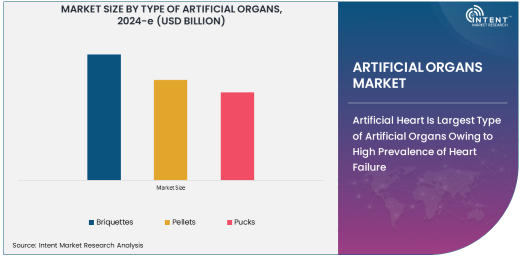
Artificial Heart Is Largest Type of Artificial Organs Owing to High Prevalence of Heart Failure
The artificial heart segment is the largest type of artificial organ, primarily due to the high prevalence of heart failure and cardiovascular diseases globally. With millions of people suffering from heart-related conditions that lead to organ failure, artificial hearts are increasingly being developed as life-saving solutions for patients who cannot receive a heart transplant. These devices are designed to temporarily or permanently replace a damaged heart, offering a critical alternative when a patient’s natural heart can no longer function.
Advancements in artificial heart technology, including improvements in mechanical circulatory support and biocompatible materials, are driving the growth of this segment. The success of heart transplantation is limited by the availability of suitable donor organs, which makes artificial hearts an important option for patients waiting for a transplant. As a result, the artificial heart remains the largest segment within the artificial organs market.
Hospitals Are Largest End-Use Industry Owing to High Demand for Surgical Interventions
Hospitals are the largest end-use industry for artificial organs, given that they are the primary healthcare settings where life-saving surgeries and treatments for organ failure are performed. These facilities provide specialized care, advanced surgical equipment, and post-operative monitoring required for the implantation of artificial organs. Hospitals also play a critical role in the management of patients requiring organ transplants or mechanical organ support, making them the largest market for artificial organs.
The increasing number of organ failure cases, along with the complexity of surgical procedures, contributes to the high demand for artificial organs within hospitals. Furthermore, hospitals continue to be at the forefront of clinical trials, testing new artificial organ technologies and offering these treatments to patients in critical need, ensuring their dominant position in the market.
Direct Sales Are Largest Distribution Channel Owing to Established Partnerships and Customization
Direct sales is the largest distribution channel in the artificial organs market, primarily due to established partnerships between medical device manufacturers and healthcare institutions such as hospitals and specialized clinics. Direct sales enable manufacturers to provide tailored solutions and support services for each institution’s specific needs, ensuring that artificial organs are delivered and implemented with the necessary guidance. This distribution channel also allows manufacturers to establish strong relationships with healthcare providers, facilitating better product support and customization based on individual patient requirements.
The need for personalized treatment options and direct communication between manufacturers and healthcare providers continues to drive the growth of the direct sales channel. As the market for artificial organs grows, manufacturers are increasingly focusing on expanding their direct sales networks to meet the demand for specialized organ replacements and support.
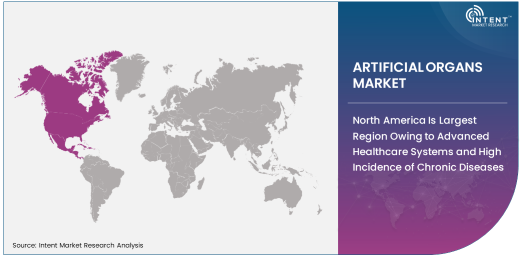
North America Is Largest Region Owing to Advanced Healthcare Systems and High Incidence of Chronic Diseases
North America is the largest region in the artificial organs market, driven by the region's advanced healthcare systems, high patient volumes, and extensive medical research infrastructure. The United States, in particular, has a high prevalence of chronic diseases such as heart disease, diabetes, and kidney failure, contributing to a growing demand for artificial organs. Moreover, North America benefits from a well-established regulatory environment, which supports the approval and commercialization of innovative medical devices, including artificial organs.
The region's strong focus on medical innovation and its large base of hospitals, medical research institutes, and healthcare providers ensure that North America remains the largest market for artificial organs. Additionally, the increasing number of clinical trials and research initiatives aimed at developing advanced artificial organs solidifies North America's leadership in the global market.
Competitive Landscape and Key Players
The artificial organs market is characterized by intense competition, with key players continually striving to innovate and develop life-saving technologies. Leading companies in this market include Abbott Laboratories, Medtronic, Carmat, and SynCardia Systems, which specialize in developing advanced artificial organs such as artificial hearts and lungs. These companies are at the forefront of the market, continually investing in research and development to enhance the functionality and longevity of artificial organs.
The competitive landscape is also marked by collaborations between medical device companies, hospitals, and research institutes to accelerate the development of new technologies. As the demand for artificial organs increases, key players are focusing on enhancing the biocompatibility and efficiency of their products, while also exploring new materials and surgical techniques to improve patient outcomes. The market is expected to grow as technological advancements continue, and the number of players investing in artificial organ innovations expands.
Recent Developments:
- SynCardia Systems, Inc. announced the successful implantation of its artificial heart device in a groundbreaking procedure aimed at extending patients’ lives while awaiting a transplant.
- Medtronic PLC expanded its portfolio with an artificial pancreas system, combining continuous glucose monitoring with insulin delivery to improve diabetes management.
- Carmat received regulatory approval for its bioprosthetic heart device, designed to provide long-term support for patients with severe heart failure.
- Berlin Heart GmbH launched a new generation of artificial heart pumps designed to enhance patient mobility and quality of life during heart failure treatment.
- Organovo Holdings, Inc. made strides in biofabrication, creating functional liver tissue for drug testing and potential transplant applications.
List of Leading Companies:
- SynCardia Systems, Inc.
- Carmat
- Berlin Heart GmbH
- Medtronic PLC
- Jarvik Heart, Inc.
- Abiomed, Inc.
- TransMedics, Inc.
- VitalHeart, Inc.
- Tandem Diabetes Care, Inc.
- B. Braun Melsungen AG
- Organovo Holdings, Inc.
- Cochlear Limited
- Advanced Bionics LLC
- HemoCleanse
- Xenotransplantation Technologies
Report Scope:
|
Report Features |
Description |
|
Market Size (2024-e) |
USD 3.2 Billion |
|
Forecasted Value (2030) |
USD 11.6 Billion |
|
CAGR (2025 – 2030) |
23.7% |
|
Base Year for Estimation |
2024-e |
|
Historic Year |
2023 |
|
Forecast Period |
2025 – 2030 |
|
Report Coverage |
Market Forecast, Market Dynamics, Competitive Landscape, Recent Developments |
|
Segments Covered |
Global Artificial Organs Market by Type of Artificial Organs (Artificial Heart, Artificial Kidney, Artificial Lungs, Artificial Liver, Artificial Pancreas), by End-Use Industry (Hospitals, Medical Research Institutes, Homecare), by Distribution Channel (Direct Sales, Medical Device Distributors, Online Platforms) |
|
Regional Analysis |
North America (US, Canada, Mexico), Europe (Germany, France, UK, Italy, Spain, and Rest of Europe), Asia-Pacific (China, Japan, South Korea, Australia, India, and Rest of Asia-Pacific), Latin America (Brazil, Argentina, and Rest of Latin America), Middle East & Africa (Saudi Arabia, UAE, Rest of Middle East & Africa) |
|
Major Companies |
SynCardia Systems, Inc., Carmat, Berlin Heart GmbH, Medtronic PLC, Jarvik Heart, Inc., Abiomed, Inc., VitalHeart, Inc., Tandem Diabetes Care, Inc., B. Braun Melsungen AG, Organovo Holdings, Inc., Cochlear Limited, Advanced Bionics LLC, Xenotransplantation Technologies |
|
Customization Scope |
Customization for segments, region/country-level will be provided. Moreover, additional customization can be done based on the requirements |
|
1. Introduction |
|
1.1. Market Definition |
|
1.2. Scope of the Study |
|
1.3. Research Assumptions |
|
1.4. Study Limitations |
|
2. Research Methodology |
|
2.1. Research Approach |
|
2.1.1. Top-Down Method |
|
2.1.2. Bottom-Up Method |
|
2.1.3. Factor Impact Analysis |
|
2.2. Insights & Data Collection Process |
|
2.2.1. Secondary Research |
|
2.2.2. Primary Research |
|
2.3. Data Mining Process |
|
2.3.1. Data Analysis |
|
2.3.2. Data Validation and Revalidation |
|
2.3.3. Data Triangulation |
|
3. Executive Summary |
|
3.1. Major Markets & Segments |
|
3.2. Highest Growing Regions and Respective Countries |
|
3.3. Impact of Growth Drivers & Inhibitors |
|
3.4. Regulatory Overview by Country |
|
4. Artificial Organs Market, by Type of Artificial Organs (Market Size & Forecast: USD Million, 2023 – 2030) |
|
4.1. Artificial Heart |
|
4.2. Artificial Kidney |
|
4.3. Artificial Lungs |
|
4.4. Artificial Liver |
|
4.5. Artificial Pancreas |
|
5. Artificial Organs Market, by End-Use Industry (Market Size & Forecast: USD Million, 2023 – 2030) |
|
5.1. Hospitals |
|
5.2. Medical Research Institutes |
|
5.3. Homecare |
|
6. Artificial Organs Market, by Distribution Channel (Market Size & Forecast: USD Million, 2023 – 2030) |
|
6.1. Direct Sales |
|
6.2. Medical Device Distributors |
|
6.3. Online Platforms |
|
7. Regional Analysis (Market Size & Forecast: USD Million, 2023 – 2030) |
|
7.1. Regional Overview |
|
7.2. North America |
|
7.2.1. Regional Trends & Growth Drivers |
|
7.2.2. Barriers & Challenges |
|
7.2.3. Opportunities |
|
7.2.4. Factor Impact Analysis |
|
7.2.5. Technology Trends |
|
7.2.6. North America Artificial Organs Market, by Type of Artificial Organs |
|
7.2.7. North America Artificial Organs Market, by End-Use Industry |
|
7.2.8. North America Artificial Organs Market, by Distribution Channel |
|
7.2.9. By Country |
|
7.2.9.1. US |
|
7.2.9.1.1. US Artificial Organs Market, by Type of Artificial Organs |
|
7.2.9.1.2. US Artificial Organs Market, by End-Use Industry |
|
7.2.9.1.3. US Artificial Organs Market, by Distribution Channel |
|
7.2.9.2. Canada |
|
7.2.9.3. Mexico |
|
*Similar segmentation will be provided for each region and country |
|
7.3. Europe |
|
7.4. Asia-Pacific |
|
7.5. Latin America |
|
7.6. Middle East & Africa |
|
8. Competitive Landscape |
|
8.1. Overview of the Key Players |
|
8.2. Competitive Ecosystem |
|
8.2.1. Level of Fragmentation |
|
8.2.2. Market Consolidation |
|
8.2.3. Product Innovation |
|
8.3. Company Share Analysis |
|
8.4. Company Benchmarking Matrix |
|
8.4.1. Strategic Overview |
|
8.4.2. Product Innovations |
|
8.5. Start-up Ecosystem |
|
8.6. Strategic Competitive Insights/ Customer Imperatives |
|
8.7. ESG Matrix/ Sustainability Matrix |
|
8.8. Manufacturing Network |
|
8.8.1. Locations |
|
8.8.2. Supply Chain and Logistics |
|
8.8.3. Product Flexibility/Customization |
|
8.8.4. Digital Transformation and Connectivity |
|
8.8.5. Environmental and Regulatory Compliance |
|
8.9. Technology Readiness Level Matrix |
|
8.10. Technology Maturity Curve |
|
8.11. Buying Criteria |
|
9. Company Profiles |
|
9.1. SynCardia Systems, Inc. |
|
9.1.1. Company Overview |
|
9.1.2. Company Financials |
|
9.1.3. Product/Service Portfolio |
|
9.1.4. Recent Developments |
|
9.1.5. IMR Analysis |
|
*Similar information will be provided for other companies |
|
9.2. Carmat |
|
9.3. Berlin Heart GmbH |
|
9.4. Medtronic PLC |
|
9.5. Jarvik Heart, Inc. |
|
9.6. Abiomed, Inc. |
|
9.7. TransMedics, Inc. |
|
9.8. VitalHeart, Inc. |
|
9.9. Tandem Diabetes Care, Inc. |
|
9.10. B. Braun Melsungen AG |
|
9.11. Organovo Holdings, Inc. |
|
9.12. Cochlear Limited |
|
9.13. Advanced Bionics LLC |
|
9.14. HemoCleanse |
|
9.15. Xenotransplantation Technologies |
|
10. Appendix |
A comprehensive market research approach was employed to gather and analyze data on the Artificial Organs Market. In the process, the analysis was also done to analyze the parent market and relevant adjacencies to measure the impact of them on the Artificial Organs Market. The research methodology encompassed both secondary and primary research techniques, ensuring the accuracy and credibility of the findings.
.jpg)
Secondary Research
Secondary research involved a thorough review of pertinent industry reports, journals, articles, and publications. Additionally, annual reports, press releases, and investor presentations of industry players were scrutinized to gain insights into their market positioning and strategies.
Primary Research
Primary research involved conducting in-depth interviews with industry experts, stakeholders, and market participants across the E-Waste Management ecosystem. The primary research objectives included:
- Validating findings and assumptions derived from secondary research
- Gathering qualitative and quantitative data on market trends, drivers, and challenges
- Understanding the demand-side dynamics, encompassing end-users, component manufacturers, facility providers, and service providers
- Assessing the supply-side landscape, including technological advancements and recent developments
Market Size Assessment
A combination of top-down and bottom-up approaches was utilized to analyze the overall size of the Artificial Organs Market. These methods were also employed to assess the size of various subsegments within the market. The market size assessment methodology encompassed the following steps:
- Identification of key industry players and relevant revenues through extensive secondary research
- Determination of the industry's supply chain and market size, in terms of value, through primary and secondary research processes
- Calculation of percentage shares, splits, and breakdowns using secondary sources and verification through primary sources
.jpg)
Data Triangulation
To ensure the accuracy and reliability of the market size, data triangulation was implemented. This involved cross-referencing data from various sources, including demand and supply side factors, market trends, and expert opinions. Additionally, top-down and bottom-up approaches were employed to validate the market size assessment.
NA