
As per Intent Market Research, the Anti-Infective Endotracheal Tube Market was valued at USD 1.2 Billion in 2024-e and will surpass USD 1.8 Billion by 2030; growing at a CAGR of 7.0% during 2025 - 2030.
The anti-infective endotracheal tube market is crucial in the healthcare sector, particularly for managing patients who require mechanical ventilation. These tubes are designed to secure the airway and deliver oxygen, while also preventing infections that can arise from prolonged ventilation, such as ventilator-associated pneumonia (VAP). The market is driven by an increasing number of surgeries, critical care cases, and the need for infection control in intensive care units (ICUs). Innovations in tube materials and designs have further supported market growth, as healthcare providers seek to reduce the risk of infections associated with ventilator use. With ongoing advancements in anti-infective technology, these tubes play a critical role in improving patient outcomes and reducing complications during and after surgeries.
As demand for critical care rises globally, especially with an aging population and an increase in respiratory diseases, the market for anti-infective endotracheal tubes is expected to grow. Their role in preventing post-surgical infections and ventilator-associated pneumonia, alongside the adoption of more efficient materials and designs, continues to drive adoption across hospitals, surgical centers, and emergency care units.
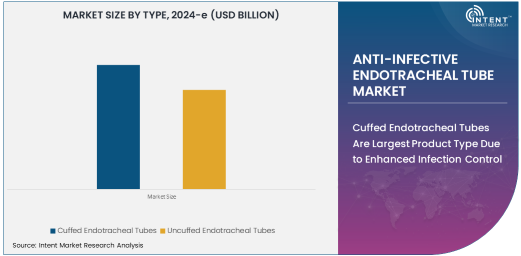
Cuffed Endotracheal Tubes Are Largest Product Type Due to Enhanced Infection Control
Cuffed endotracheal tubes are the largest product type in the anti-infective endotracheal tube market due to their superior infection control properties and ability to prevent aspiration of fluids into the lungs, a common cause of ventilator-associated pneumonia (VAP). The cuff, which forms a seal within the trachea, helps maintain airway patency and prevents the leakage of secretions that may lead to infection. This feature is especially critical for patients undergoing mechanical ventilation for extended periods, as it minimizes the risk of bacterial colonization and subsequent infection.
Cuffed endotracheal tubes are widely used in intensive care units (ICUs) and surgical centers, where patients are at higher risk of infections. As healthcare facilities continue to prioritize infection prevention, cuffed endotracheal tubes remain the preferred choice for maintaining airway integrity while providing robust protection against pulmonary infections, further driving their dominance in the market.
Hospitals Are Largest End-Use Industry Due to High Demand for Critical Care
Hospitals are the largest end-use industry for anti-infective endotracheal tubes due to the high volume of patients requiring mechanical ventilation, especially in critical care and intensive care units (ICUs). Hospitals treat a broad spectrum of patients, including those with respiratory distress, surgical patients, and those with severe infections, all of whom may require ventilation support. The use of anti-infective endotracheal tubes in hospitals helps to reduce the risk of infections like VAP, which can significantly complicate patient recovery and prolong hospital stays.
Hospitals are equipped with advanced medical facilities and staff that can manage high-risk patients, making them the primary setting for the use of these tubes. As the number of respiratory and critical care patients increases, hospitals will continue to drive the demand for anti-infective endotracheal tubes to ensure optimal patient care and infection prevention during mechanical ventilation.
North America Is Largest Region Due to Advanced Healthcare Infrastructure
North America is the largest region in the anti-infective endotracheal tube market, owing to its advanced healthcare infrastructure, high levels of healthcare spending, and a strong presence of key medical device manufacturers. The United States, in particular, leads in the adoption of anti-infective endotracheal tubes due to its large number of hospitals and intensive care units (ICUs) that are equipped to handle complex cases requiring ventilatory support. The region also benefits from a well-established healthcare system, which emphasizes infection prevention and control in critical care settings, thus contributing to the increased use of these tubes.
In addition, the region’s robust research and development sector, along with a focus on improving patient outcomes, has led to the introduction of more advanced anti-infective endotracheal tubes. As healthcare awareness grows and the prevalence of respiratory conditions rises, North America will continue to maintain its leading position in the market.
Competitive Landscape and Key Players
The competitive landscape of the anti-infective endotracheal tube market includes key players such as Medtronic, Smiths Medical, and Teleflex, who dominate the production of endotracheal tubes used in critical care settings. These companies lead the market by providing a wide range of cuffed and uncuffed endotracheal tubes, often with advanced features such as infection-resistant coatings and materials designed to reduce the risk of bacterial growth.
Innovation and product development are key strategies in this market, as manufacturers continuously improve the design and functionality of these tubes to enhance infection prevention and patient safety. Strategic collaborations with hospitals, surgical centers, and emergency care units also play a significant role in expanding market presence. As the focus on infection control intensifies, these companies are expected to play a crucial role in shaping the future of the anti-infective endotracheal tube market by offering innovative, effective solutions for healthcare providers.
Recent Developments:
- Medtronic announced the launch of a new antimicrobial endotracheal tube to reduce infection risks in ventilated patients.
- Teleflex Incorporated introduced a novel cuffed endotracheal tube with a built-in antimicrobial coating designed to minimize bacterial growth.
- Boston Scientific Corporation secured FDA approval for its advanced anti-infective endotracheal tube, aimed at reducing ventilator-associated pneumonia in ICU patients.
- Fisher & Paykel Healthcare expanded its product portfolio by adding disposable antimicrobial endotracheal tubes for use in both hospital and emergency settings.
- Smiths Medical partnered with a biotech firm to enhance their endotracheal tube technology, integrating a unique infection-resistant coating.
List of Leading Companies:
- Medtronic
- Boston Scientific Corporation
- Smiths Medical
- ConvaTec
- Teleflex Incorporated
- Halyard Health
- Fisher & Paykel Healthcare
- Vyaire Medical
- Surgical Innovations Group
- Intubation Medical Devices, Inc.
- Cook Medical
- Becton, Dickinson and Company (BD)
- Truphatek International
- LMA North America
- Intersurgical
Report Scope:
|
Report Features |
Description |
|
Market Size (2024-e) |
USD 1.2 Billion |
|
Forecasted Value (2030) |
USD 1.8 Billion |
|
CAGR (2025 – 2030) |
7.0% |
|
Base Year for Estimation |
2024-e |
|
Historic Year |
2023 |
|
Forecast Period |
2025 – 2030 |
|
Report Coverage |
Market Forecast, Market Dynamics, Competitive Landscape, Recent Developments |
|
Segments Covered |
Global Anti-Infective Endotracheal Tube Market by Type (Cuffed Endotracheal Tubes, Uncuffed Endotracheal Tubes), by Material (PVC, Silicone, Rubber), by Application (Preventing Ventilator-Associated Pneumonia, Reducing Infection Risks in ICU, Post-Surgery Infection Control); Insights & Forecast (2024 – 2030) |
|
Regional Analysis |
North America (US, Canada, Mexico), Europe (Germany, France, UK, Italy, Spain, and Rest of Europe), Asia-Pacific (China, Japan, South Korea, Australia, India, and Rest of Asia-Pacific), Latin America (Brazil, Argentina, and Rest of Latin America), Middle East & Africa (Saudi Arabia, UAE, Rest of Middle East & Africa) |
|
Major Companies |
Medtronic, Boston Scientific Corporation, Smiths Medical, ConvaTec, Teleflex Incorporated, Halyard Health, Vyaire Medical, Surgical Innovations Group, Intubation Medical Devices, Inc., Cook Medical, Becton, Dickinson and Company (BD), Truphatek International, Intersurgical, |
|
Customization Scope |
Customization for segments, region/country-level will be provided. Moreover, additional customization can be done based on the requirements |
|
1. Introduction |
|
1.1. Market Definition |
|
1.2. Scope of the Study |
|
1.3. Research Assumptions |
|
1.4. Study Limitations |
|
2. Research Methodology |
|
2.1. Research Approach |
|
2.1.1. Top-Down Method |
|
2.1.2. Bottom-Up Method |
|
2.1.3. Factor Impact Analysis |
|
2.2. Insights & Data Collection Process |
|
2.2.1. Secondary Research |
|
2.2.2. Primary Research |
|
2.3. Data Mining Process |
|
2.3.1. Data Analysis |
|
2.3.2. Data Validation and Revalidation |
|
2.3.3. Data Triangulation |
|
3. Executive Summary |
|
3.1. Major Markets & Segments |
|
3.2. Highest Growing Regions and Respective Countries |
|
3.3. Impact of Growth Drivers & Inhibitors |
|
3.4. Regulatory Overview by Country |
|
4. Anti-Infective Endotracheal Tube Market, by Type (Market Size & Forecast: USD Million, 2023 – 2030) |
|
4.1. Cuffed Endotracheal Tubes |
|
4.2. Uncuffed Endotracheal Tubes |
|
5. Anti-Infective Endotracheal Tube Market, by Material (Market Size & Forecast: USD Million, 2023 – 2030) |
|
5.1. PVC (Polyvinyl Chloride) |
|
5.2. Silicone |
|
5.3. Rubber |
|
6. Anti-Infective Endotracheal Tube Market, by Application (Market Size & Forecast: USD Million, 2023 – 2030) |
|
6.1. Preventing Ventilator-Associated Pneumonia |
|
6.2. Reducing Infection Risks in ICU |
|
6.3. Post-Surgery Infection Control |
|
7. Anti-Infective Endotracheal Tube Market, by End-Use Industry (Market Size & Forecast: USD Million, 2023 – 2030) |
|
7.1. Hospitals |
|
7.2. Surgical Centers |
|
7.3. Emergency Care Units |
|
8. Regional Analysis (Market Size & Forecast: USD Million, 2023 – 2030) |
|
8.1. Regional Overview |
|
8.2. North America |
|
8.2.1. Regional Trends & Growth Drivers |
|
8.2.2. Barriers & Challenges |
|
8.2.3. Opportunities |
|
8.2.4. Factor Impact Analysis |
|
8.2.5. Technology Trends |
|
8.2.6. North America Anti-Infective Endotracheal Tube Market, by Type |
|
8.2.7. North America Anti-Infective Endotracheal Tube Market, by Material |
|
8.2.8. North America Anti-Infective Endotracheal Tube Market, by Application |
|
8.2.9. North America Anti-Infective Endotracheal Tube Market, by End-Use Industry |
|
8.2.10. By Country |
|
8.2.10.1. US |
|
8.2.10.1.1. US Anti-Infective Endotracheal Tube Market, by Type |
|
8.2.10.1.2. US Anti-Infective Endotracheal Tube Market, by Material |
|
8.2.10.1.3. US Anti-Infective Endotracheal Tube Market, by Application |
|
8.2.10.1.4. US Anti-Infective Endotracheal Tube Market, by End-Use Industry |
|
8.2.10.2. Canada |
|
8.2.10.3. Mexico |
|
*Similar segmentation will be provided for each region and country |
|
8.3. Europe |
|
8.4. Asia-Pacific |
|
8.5. Latin America |
|
8.6. Middle East & Africa |
|
9. Competitive Landscape |
|
9.1. Overview of the Key Players |
|
9.2. Competitive Ecosystem |
|
9.2.1. Level of Fragmentation |
|
9.2.2. Market Consolidation |
|
9.2.3. Product Innovation |
|
9.3. Company Share Analysis |
|
9.4. Company Benchmarking Matrix |
|
9.4.1. Strategic Overview |
|
9.4.2. Product Innovations |
|
9.5. Start-up Ecosystem |
|
9.6. Strategic Competitive Insights/ Customer Imperatives |
|
9.7. ESG Matrix/ Sustainability Matrix |
|
9.8. Manufacturing Network |
|
9.8.1. Locations |
|
9.8.2. Supply Chain and Logistics |
|
9.8.3. Product Flexibility/Customization |
|
9.8.4. Digital Transformation and Connectivity |
|
9.8.5. Environmental and Regulatory Compliance |
|
9.9. Technology Readiness Level Matrix |
|
9.10. Technology Maturity Curve |
|
9.11. Buying Criteria |
|
10. Company Profiles |
|
10.1. Medtronic |
|
10.1.1. Company Overview |
|
10.1.2. Company Financials |
|
10.1.3. Product/Service Portfolio |
|
10.1.4. Recent Developments |
|
10.1.5. IMR Analysis |
|
*Similar information will be provided for other companies |
|
10.2. Boston Scientific Corporation |
|
10.3. Smiths Medical |
|
10.4. ConvaTec |
|
10.5. Teleflex Incorporated |
|
10.6. Halyard Health |
|
10.7. Fisher & Paykel Healthcare |
|
10.8. Vyaire Medical |
|
10.9. Surgical Innovations Group |
|
10.10. Intubation Medical Devices, Inc. |
|
10.11. Cook Medical |
|
10.12. Becton, Dickinson and Company (BD) |
|
10.13. Truphatek International |
|
10.14. LMA North America |
|
10.15. Intersurgical |
|
11. Appendix |
A comprehensive market research approach was employed to gather and analyze data on the Anti-Infective Endotracheal Tube Market. In the process, the analysis was also done to analyze the parent market and relevant adjacencies to measure the impact of them on the Anti-Infective Endotracheal Tube Market. The research methodology encompassed both secondary and primary research techniques, ensuring the accuracy and credibility of the findings.
.jpg)
Secondary Research
Secondary research involved a thorough review of pertinent industry reports, journals, articles, and publications. Additionally, annual reports, press releases, and investor presentations of industry players were scrutinized to gain insights into their market positioning and strategies.
Primary Research
Primary research involved conducting in-depth interviews with industry experts, stakeholders, and market participants across the E-Waste Management ecosystem. The primary research objectives included:
- Validating findings and assumptions derived from secondary research
- Gathering qualitative and quantitative data on market trends, drivers, and challenges
- Understanding the demand-side dynamics, encompassing end-users, component manufacturers, facility providers, and service providers
- Assessing the supply-side landscape, including technological advancements and recent developments
Market Size Assessment
A combination of top-down and bottom-up approaches was utilized to analyze the overall size of the Anti-Infective Endotracheal Tube Market. These methods were also employed to assess the size of various subsegments within the market. The market size assessment methodology encompassed the following steps:
- Identification of key industry players and relevant revenues through extensive secondary research
- Determination of the industry's supply chain and market size, in terms of value, through primary and secondary research processes
- Calculation of percentage shares, splits, and breakdowns using secondary sources and verification through primary sources
.jpg)
Data Triangulation
To ensure the accuracy and reliability of the market size, data triangulation was implemented. This involved cross-referencing data from various sources, including demand and supply side factors, market trends, and expert opinions. Additionally, top-down and bottom-up approaches were employed to validate the market size assessment.
NA