
As per Intent Market Research, the Analytical Instrumentation Market was valued at USD 7.6 Billion in 2024-e and will surpass USD 12.8 Billion by 2030; growing at a CAGR of 7.7% during 2025-2030.
The analytical instrumentation market has seen significant growth due to the increasing demand for precise and reliable data across various industries. These advanced instruments provide critical insights into complex chemical compositions, molecular structures, and physical properties, which are essential for industries such as pharmaceuticals, environmental testing, and food & beverage production. The constant innovation and integration of cutting-edge technologies in analytical instruments ensure their widespread adoption in research, quality control, and process optimization.
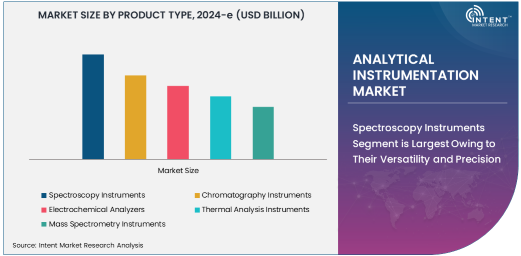
Spectroscopy Instruments Segment is Largest Owing to Their Versatility and Precision
Spectroscopy instruments dominate the analytical instrumentation market due to their wide applicability across industries. These instruments, including UV-Vis, IR, and NMR spectroscopy, offer unmatched precision in analyzing molecular structures, composition, and properties of substances.
Spectroscopy’s ability to provide detailed data in real-time makes it essential for industries like pharmaceuticals, environmental testing, and research institutions. The versatility and accuracy of these instruments ensure their consistent demand and dominance within the market.
High-Performance Liquid Chromatography (HPLC) Segment is Fastest Growing Owing to Rising Pharmaceutical and Food Safety Testing
High-Performance Liquid Chromatography (HPLC) is the fastest-growing technology segment, driven by the increasing need for thorough drug testing and food safety regulations.
HPLC provides unmatched sensitivity and separation capabilities, making it essential for pharmaceuticals to ensure drug efficacy and safety, while also being widely adopted in environmental testing and food processing for detecting contaminants and impurities.
Pharmaceutical Application is Largest Due to Increasing Drug Development and Quality Control
The pharmaceutical application segment leads the market, primarily due to the rapid advancements in drug development and quality assurance. Analytical instruments like Mass Spectrometry and NMR are extensively used to ensure the highest standards of drug safety and efficacy.
With stringent regulations and the rising demand for innovative pharmaceuticals, analytical instrumentation has become indispensable for ensuring quality control and efficient production processes.
Asia-Pacific Region is Fastest Growing Due to Growing Industrial and Research Capabilities
The Asia-Pacific region is the fastest-growing region in the analytical instrumentation market, driven by rapid industrialization and increasing investments in research and development.
Countries like China, India, and Japan are expanding their manufacturing and research capabilities, thereby fueling the demand for advanced analytical instruments in sectors such as pharmaceuticals, environmental testing, and food processing.

Competitive Landscape and Leading Companies
The analytical instrumentation market is highly competitive, with key players focusing on technological advancements and strategic collaborations. Companies like Agilent Technologies, Thermo Fisher Scientific, and PerkinElmer are leading the market with a diverse portfolio of analytical instruments catering to various industries.
The competitive landscape is characterized by continuous innovation, with companies offering tailored solutions for specific applications, ensuring their competitive edge in a rapidly evolving market.
Recent Developments:
- Thermo Fisher Scientific recently introduced an advanced high-performance liquid chromatography (HPLC) system designed for precision and efficiency in pharmaceuticals and food testing.
- Agilent Technologies announced the acquisition of SPECTRO Analytical Instruments to strengthen its capabilities in materials analysis and scientific instrumentation.
- Shimadzu Corporation has unveiled new solutions for environmental monitoring, enhancing its portfolio for waste management and pollution control.
- PerkinElmer secured regulatory approvals for its new series of high-precision spectroscopy instruments tailored for research and diagnostics applications.
- Waters Corporation launched a new AI-powered software suite for chromatography and mass spectrometry, aimed at improving data interpretation and efficiency.
List of Leading Companies:
- Agilent Technologies
- Thermo Fisher Scientific
- PerkinElmer
- Waters Corporation
- Bruker
- Shimadzu Corporation
- Agra Analytical
- Hitachi High-Tech
- Yokogawa Electric Corporation
- JEOL Ltd.
- Horiba Ltd.
- SRI Instruments
- Analytik Jena AG
- Metrohm AG
- WATERS Corp.
Report Scope:
|
Report Features |
Description |
|
Market Size (2024-e) |
USD 7.6 Billion |
|
Forecasted Value (2030) |
USD 12.8 Billion |
|
CAGR (2025 – 2030) |
7.7% |
|
Base Year for Estimation |
2024-e |
|
Historic Year |
2023 |
|
Forecast Period |
2025 – 2030 |
|
Report Coverage |
Market Forecast, Market Dynamics, Competitive Landscape, Recent Developments |
|
Segments Covered |
Analytical Instrumentation Market By Product Type (Spectroscopy Instruments, Chromatography Instruments, Electrochemical Analyzers, Thermal Analysis Instruments, Mass Spectrometry Instruments), By Technology (High-Performance Liquid Chromatography (HPLC), Gas Chromatography-Mass Spectrometry (GC-MS), Nuclear Magnetic Resonance (NMR), Fourier Transform Infrared (FTIR), Atomic Absorption Spectroscopy (AAS)), By Application (Pharmaceuticals, Environmental Testing, Food & Beverage, Chemicals, Academic Research), By End-Use Industry (Healthcare, Environmental Agencies, Research Institutions, Food Processing, Chemical Industry), and By Region |
|
Regional Analysis |
North America (US, Canada, Mexico), Europe (Germany, France, UK, Italy, Spain, and Rest of Europe), Asia-Pacific (China, Japan, South Korea, Australia, India, and Rest of Asia-Pacific), Latin America (Brazil, Argentina, and Rest of Latin America), Middle East & Africa (Saudi Arabia, UAE, Rest of Middle East & Africa) |
|
Major Companies |
Agilent Technologies, Thermo Fisher Scientific, PerkinElmer, Waters Corporation, Bruker, Shimadzu Corporation, Agra Analytical, Hitachi High-Tech, Yokogawa Electric Corporation, JEOL Ltd., Horiba Ltd., SRI Instruments, Analytik Jena AG, Metrohm AG, WATERS Corp. |
|
Customization Scope |
Customization for segments, region/country-level will be provided. Moreover, additional customization can be done based on the requirements |
|
1. Introduction |
|
1.1. Market Definition |
|
1.2. Scope of the Study |
|
1.3. Research Assumptions |
|
1.4. Study Limitations |
|
2. Research Methodology |
|
2.1. Research Approach |
|
2.1.1. Top-Down Method |
|
2.1.2. Bottom-Up Method |
|
2.1.3. Factor Impact Analysis |
|
2.2. Insights & Data Collection Process |
|
2.2.1. Secondary Research |
|
2.2.2. Primary Research |
|
2.3. Data Mining Process |
|
2.3.1. Data Analysis |
|
2.3.2. Data Validation and Revalidation |
|
2.3.3. Data Triangulation |
|
3. Executive Summary |
|
3.1. Major Markets & Segments |
|
3.2. Highest Growing Regions and Respective Countries |
|
3.3. Impact of Growth Drivers & Inhibitors |
|
3.4. Regulatory Overview by Country |
|
4. Analytical Instrumentation Market, by Product Type (Market Size & Forecast: USD Million, 2023 – 2030) |
|
4.1. Spectroscopy Instruments |
|
4.2. Chromatography Instruments |
|
4.3. Electrochemical Analyzers |
|
4.4. Thermal Analysis Instruments |
|
4.5. Mass Spectrometry Instruments |
|
5. Analytical Instrumentation Market, by Technology (Market Size & Forecast: USD Million, 2023 – 2030) |
|
5.1. High-Performance Liquid Chromatography (HPLC) |
|
5.2. Gas Chromatography-Mass Spectrometry (GC-MS) |
|
5.3. Nuclear Magnetic Resonance (NMR) |
|
5.4. Fourier Transform Infrared (FTIR) |
|
5.5. Atomic Absorption Spectroscopy (AAS) |
|
6. Analytical Instrumentation Market, by Application (Market Size & Forecast: USD Million, 2023 – 2030) |
|
6.1. Pharmaceuticals |
|
6.2. Environmental Testing |
|
6.3. Food & Beverage |
|
6.4. Chemicals |
|
6.5. Academic Research |
|
7. Analytical Instrumentation Market, by End-Use Industry (Market Size & Forecast: USD Million, 2023 – 2030) |
|
7.1. Healthcare |
|
7.2. Environmental Agencies |
|
7.3. Research Institutions |
|
7.4. Food Processing |
|
7.5. Chemical Industry |
|
8. Regional Analysis (Market Size & Forecast: USD Million, 2023 – 2030) |
|
8.1. Regional Overview |
|
8.2. North America |
|
8.2.1. Regional Trends & Growth Drivers |
|
8.2.2. Barriers & Challenges |
|
8.2.3. Opportunities |
|
8.2.4. Factor Impact Analysis |
|
8.2.5. Technology Trends |
|
8.2.6. North America Analytical Instrumentation Market, by Product Type |
|
8.2.7. North America Analytical Instrumentation Market, by Technology |
|
8.2.8. North America Analytical Instrumentation Market, by Application |
|
8.2.9. North America Analytical Instrumentation Market, by End-Use Industry |
|
8.2.10. By Country |
|
8.2.10.1. US |
|
8.2.10.1.1. US Analytical Instrumentation Market, by Product Type |
|
8.2.10.1.2. US Analytical Instrumentation Market, by Technology |
|
8.2.10.1.3. US Analytical Instrumentation Market, by Application |
|
8.2.10.1.4. US Analytical Instrumentation Market, by End-Use Industry |
|
8.2.10.2. Canada |
|
8.2.10.3. Mexico |
|
*Similar segmentation will be provided for each region and country |
|
8.3. Europe |
|
8.4. Asia-Pacific |
|
8.5. Latin America |
|
8.6. Middle East & Africa |
|
9. Competitive Landscape |
|
9.1. Overview of the Key Players |
|
9.2. Competitive Ecosystem |
|
9.2.1. Level of Fragmentation |
|
9.2.2. Market Consolidation |
|
9.2.3. Product Innovation |
|
9.3. Company Share Analysis |
|
9.4. Company Benchmarking Matrix |
|
9.4.1. Strategic Overview |
|
9.4.2. Product Innovations |
|
9.5. Start-up Ecosystem |
|
9.6. Strategic Competitive Insights/ Customer Imperatives |
|
9.7. ESG Matrix/ Sustainability Matrix |
|
9.8. Manufacturing Network |
|
9.8.1. Locations |
|
9.8.2. Supply Chain and Logistics |
|
9.8.3. Product Flexibility/Customization |
|
9.8.4. Digital Transformation and Connectivity |
|
9.8.5. Environmental and Regulatory Compliance |
|
9.9. Technology Readiness Level Matrix |
|
9.10. Technology Maturity Curve |
|
9.11. Buying Criteria |
|
10. Company Profiles |
|
10.1. Agilent Technologies |
|
10.1.1. Company Overview |
|
10.1.2. Company Financials |
|
10.1.3. Product/Service Portfolio |
|
10.1.4. Recent Developments |
|
10.1.5. IMR Analysis |
|
*Similar information will be provided for other companies |
|
10.2. Thermo Fisher Scientific |
|
10.3. PerkinElmer |
|
10.4. Waters Corporation |
|
10.5. Bruker |
|
10.6. Shimadzu Corporation |
|
10.7. Agra Analytical |
|
10.8. Hitachi High-Tech |
|
10.9. Yokogawa Electric Corporation |
|
10.10. JEOL Ltd. |
|
10.11. Horiba Ltd. |
|
10.12. SRI Instruments |
|
10.13. Analytik Jena AG |
|
10.14. Metrohm AG |
|
10.15. WATERS Corp. |
|
11. Appendix |
A comprehensive market research approach was employed to gather and analyze data on the Analytical Instrumentation Market. In the process, the analysis was also done to analyze the parent market and relevant adjacencies to measure the impact of them on the Analytical Instrumentation Market. The research methodology encompassed both secondary and primary research techniques, ensuring the accuracy and credibility of the findings.
.jpg)
Secondary Research
Secondary research involved a thorough review of pertinent industry reports, journals, articles, and publications. Additionally, annual reports, press releases, and investor presentations of industry players were scrutinized to gain insights into their market positioning and strategies.
Primary Research
Primary research involved conducting in-depth interviews with industry experts, stakeholders, and market participants across the E-Waste Management ecosystem. The primary research objectives included:
- Validating findings and assumptions derived from secondary research
- Gathering qualitative and quantitative data on market trends, drivers, and challenges
- Understanding the demand-side dynamics, encompassing end-users, component manufacturers, facility providers, and service providers
- Assessing the supply-side landscape, including technological advancements and recent developments
Market Size Assessment
A combination of top-down and bottom-up approaches was utilized to analyze the overall size of the Analytical Instrumentation Market. These methods were also employed to assess the size of various subsegments within the market. The market size assessment methodology encompassed the following steps:
- Identification of key industry players and relevant revenues through extensive secondary research
- Determination of the industry's supply chain and market size, in terms of value, through primary and secondary research processes
- Calculation of percentage shares, splits, and breakdowns using secondary sources and verification through primary sources
.jpg)
Data Triangulation
To ensure the accuracy and reliability of the market size, data triangulation was implemented. This involved cross-referencing data from various sources, including demand and supply side factors, market trends, and expert opinions. Additionally, top-down and bottom-up approaches were employed to validate the market size assessment.
NA