
As per Intent Market Research, the Anal Cancer Treatment Market was valued at USD 0.7 Billion in 2024-e and will surpass USD 1.4 Billion by 2030; growing at a CAGR of 9.4% during 2025-2030.
The anal cancer treatment market has witnessed significant advancements in recent years, driven by increasing awareness, advancements in medical technology, and rising cancer incidences globally. With a growing geriatric population and a higher prevalence of risk factors such as Human Papillomavirus (HPV), the demand for effective and innovative treatment options has surged. The market offers a variety of therapies, ranging from traditional approaches like chemotherapy and radiation therapy to advanced treatments like immunotherapy and targeted therapies. As cancer stages progress, the focus is shifting towards personalized treatment plans to improve patient outcomes and quality of life.
Chemotherapy Segment is Largest Owing to its role in reducing the tumor burden
The Chemotherapy segment holds the largest share in the anal cancer treatment market due to its established role in managing and reducing the tumor burden at various stages of cancer progression. Chemotherapy has been a cornerstone in the treatment of anal cancer for several decades, providing systemic therapy that targets rapidly dividing cells. This subsegment is especially prevalent in advanced stages (Stage III and IV) where surgical and radiation approaches may not be sufficient on their own. In regions with well-established healthcare infrastructures, such as North America and Europe, chemotherapy remains a primary treatment modality due to its efficacy and accessibility.

Stage IV Segment is Fastest Growing Owing to advancements in treatment options for advanced-stage disease
The Stage IV segment is the fastest growing within the anal cancer treatment market, reflecting advancements in treatment options for metastatic or advanced-stage disease. With the introduction of immunotherapy and targeted therapies, Stage IV patients now have more comprehensive and personalized treatment approaches. In regions like Asia-Pacific, where cancer prevalence is rapidly increasing, the demand for innovative Stage IV cancer solutions is surging. Additionally, clinical trials focusing on advanced-stage cancers are expanding, driving growth in this subsegment due to improved patient outcomes and extended survival rates.
Radiation Therapy Segment is Largest Owing to its minimal systemic toxicity control
The Radiation Therapy segment continues to dominate the market for early to intermediate stages of anal cancer (Stage I and II), as it provides localized control of the disease with minimal systemic toxicity. This treatment modality is widely used due to its non-invasive nature and the ability to precisely target cancer cells while sparing healthy tissues. In regions with high cancer incidence rates, such as North America and Europe, radiation therapy is a preferred option for managing anal cancer, given its high success rate and fewer side effects compared to traditional chemotherapy.
Hospitals Segment is Largest Owing to specialized oncology units, and advanced diagnostic technologies
The Hospitals segment dominates the end-user category in anal cancer treatment due to their comprehensive care facilities, specialized oncology units, and advanced diagnostic technologies. Hospitals serve as primary hubs for cancer management, offering a wide range of therapies including chemotherapy, radiation, and targeted treatments. In regions like the United States and Germany, hospitals are equipped with state-of-the-art infrastructure and multidisciplinary teams to provide holistic cancer care. The growing burden of cancer has led hospitals to invest heavily in expanding their oncology departments and integrating advanced treatment options.
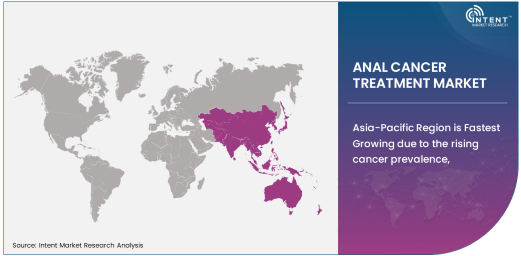
Asia-Pacific Region is Fastest Growing
The Asia-Pacific region is the fastest-growing market for anal cancer treatment, primarily due to the rising cancer prevalence, increasing healthcare expenditure, and improvements in healthcare infrastructure. Countries such as China and India are witnessing a surge in cancer cases, leading to a higher demand for advanced treatment options like immunotherapy and targeted therapies. Additionally, government initiatives and collaborations with pharmaceutical companies are enhancing the accessibility of novel treatment solutions, fostering rapid growth in this region.
Competitive Landscape
The competitive landscape of the anal cancer treatment market is marked by the presence of leading pharmaceutical and biotech companies that focus on research and development of innovative therapies. Companies such as Bristol-Myers Squibb, Merck & Co., and Pfizer are at the forefront, offering cutting-edge solutions through a combination of clinical trials and strategic collaborations. The competitive environment is further intensified by the focus on personalized medicine, where companies are leveraging biomarkers and advanced diagnostic tools to tailor treatment approaches. As cancer treatment becomes more targeted, partnerships between healthcare providers and pharmaceutical companies continue to drive advancements in patient care and improve overall outcomes.
Recent Developments:
- Bristol-Myers Squibb launched a new targeted therapy specifically for advanced-stage anal cancer patients.
- Pfizer Inc. entered into a partnership to advance immunotherapy options for anal cancer.
- Merck & Co., Inc. received FDA approval for an innovative drug combining chemotherapy and radiation for Stage II anal cancer.
- Roche Holding AG acquired a company specializing in cancer diagnostic solutions to enhance treatment accuracy.
- Novartis International AG expanded clinical trials focusing on personalized treatment options for advanced anal cancer.
List of Leading Companies:
- Bristol-Myers Squibb
- Pfizer Inc.
- Merck & Co., Inc.
- Johnson & Johnson
- Eli Lilly and Company
- AstraZeneca
- Roche Holding AG
- Novartis International AG
- AbbVie Inc.
- Gilead Sciences
- Bayer AG
- Sanofi
- Amgen Inc.
- Takeda Pharmaceutical
- Vertex Pharmaceuticals
Report Scope:
|
Report Features |
Description |
|
Market Size (2024-e) |
USD 0.7 Billion |
|
Forecasted Value (2030) |
USD 1.4 Billion |
|
CAGR (2025 – 2030) |
9.4% |
|
Base Year for Estimation |
2024-e |
|
Historic Year |
2023 |
|
Forecast Period |
2025 – 2030 |
|
Report Coverage |
Market Forecast, Market Dynamics, Competitive Landscape, Recent Developments |
|
Segments Covered |
Anal Cancer Treatment Market By Therapy Type (Chemotherapy, Radiation Therapy, Targeted Therapy, Immunotherapy), By Stage of Cancer (Stage I, Stage II, Stage III, Stage IV), and By End-User (Hospitals, Cancer Treatment Centers, Ambulatory Surgical Centers, Research Institutions) |
|
Regional Analysis |
North America (US, Canada, Mexico), Europe (Germany, France, UK, Italy, Spain, and Rest of Europe), Asia-Pacific (China, Japan, South Korea, Australia, India, and Rest of Asia-Pacific), Latin America (Brazil, Argentina, and Rest of Latin America), Middle East & Africa (Saudi Arabia, UAE, Rest of Middle East & Africa) |
|
Major Companies |
Bristol-Myers Squibb, Pfizer Inc., Merck & Co., Inc., Johnson & Johnson, Eli Lilly and Company, AstraZeneca, Roche Holding AG, Novartis International AG, AbbVie Inc., Gilead Sciences, Bayer AG, Sanofi, Amgen Inc., Takeda Pharmaceutical, Vertex Pharmaceuticals |
|
Customization Scope |
Customization for segments, region/country-level will be provided. Moreover, additional customization can be done based on the requirements |
|
1. Introduction |
|
1.1. Market Definition |
|
1.2. Scope of the Study |
|
1.3. Research Assumptions |
|
1.4. Study Limitations |
|
2. Research Methodology |
|
2.1. Research Approach |
|
2.1.1. Top-Down Method |
|
2.1.2. Bottom-Up Method |
|
2.1.3. Factor Impact Analysis |
|
2.2. Insights & Data Collection Process |
|
2.2.1. Secondary Research |
|
2.2.2. Primary Research |
|
2.3. Data Mining Process |
|
2.3.1. Data Analysis |
|
2.3.2. Data Validation and Revalidation |
|
2.3.3. Data Triangulation |
|
3. Executive Summary |
|
3.1. Major Markets & Segments |
|
3.2. Highest Growing Regions and Respective Countries |
|
3.3. Impact of Growth Drivers & Inhibitors |
|
3.4. Regulatory Overview by Country |
|
4. Anal Cancer Treatment Market, by Therapy Type (Market Size & Forecast: USD Million, 2023 – 2030) |
|
4.1. Chemotherapy |
|
4.2. Radiation Therapy |
|
4.3. Targeted Therapy |
|
4.4. Immunotherapy |
|
5. Anal Cancer Treatment Market, by Stage of Cancer (Market Size & Forecast: USD Million, 2023 – 2030) |
|
5.1. Stage I |
|
5.2. Stage II |
|
5.3. Stage III |
|
5.4. Stage IV |
|
6. Anal Cancer Treatment Market, by End User (Market Size & Forecast: USD Million, 2023 – 2030) |
|
6.1. Hospitals |
|
6.2. Cancer Treatment Centers |
|
6.3. Ambulatory Surgical Centers |
|
6.4. Research Institutions |
|
7. Regional Analysis (Market Size & Forecast: USD Million, 2023 – 2030) |
|
7.1. Regional Overview |
|
7.2. North America |
|
7.2.1. Regional Trends & Growth Drivers |
|
7.2.2. Barriers & Challenges |
|
7.2.3. Opportunities |
|
7.2.4. Factor Impact Analysis |
|
7.2.5. Technology Trends |
|
7.2.6. North America Anal Cancer Treatment Market, by Therapy Type |
|
7.2.7. North America Anal Cancer Treatment Market, by Stage of Cancer |
|
7.2.8. North America Anal Cancer Treatment Market, by End User |
|
7.2.9. By Country |
|
7.2.9.1. US |
|
7.2.9.1.1. US Anal Cancer Treatment Market, by Therapy Type |
|
7.2.9.1.2. US Anal Cancer Treatment Market, by Stage of Cancer |
|
7.2.9.1.3. US Anal Cancer Treatment Market, by End User |
|
7.2.9.2. Canada |
|
7.2.9.3. Mexico |
|
*Similar segmentation will be provided for each region and country |
|
7.3. Europe |
|
7.4. Asia-Pacific |
|
7.5. Latin America |
|
7.6. Middle East & Africa |
|
8. Competitive Landscape |
|
8.1. Overview of the Key Players |
|
8.2. Competitive Ecosystem |
|
8.2.1. Level of Fragmentation |
|
8.2.2. Market Consolidation |
|
8.2.3. Product Innovation |
|
8.3. Company Share Analysis |
|
8.4. Company Benchmarking Matrix |
|
8.4.1. Strategic Overview |
|
8.4.2. Product Innovations |
|
8.5. Start-up Ecosystem |
|
8.6. Strategic Competitive Insights/ Customer Imperatives |
|
8.7. ESG Matrix/ Sustainability Matrix |
|
8.8. Manufacturing Network |
|
8.8.1. Locations |
|
8.8.2. Supply Chain and Logistics |
|
8.8.3. Product Flexibility/Customization |
|
8.8.4. Digital Transformation and Connectivity |
|
8.8.5. Environmental and Regulatory Compliance |
|
8.9. Technology Readiness Level Matrix |
|
8.10. Technology Maturity Curve |
|
8.11. Buying Criteria |
|
9. Company Profiles |
|
9.1. Bristol-Myers Squibb |
|
9.1.1. Company Overview |
|
9.1.2. Company Financials |
|
9.1.3. Product/Service Portfolio |
|
9.1.4. Recent Developments |
|
9.1.5. IMR Analysis |
|
*Similar information will be provided for other companies |
|
9.2. Pfizer Inc. |
|
9.3. Merck & Co., Inc. |
|
9.4. Johnson & Johnson |
|
9.5. Eli Lilly and Company |
|
9.6. AstraZeneca |
|
9.7. Roche Holding AG |
|
9.8. Novartis International AG |
|
9.9. AbbVie Inc. |
|
9.10. Gilead Sciences |
|
9.11. Bayer AG |
|
9.12. Sanofi |
|
9.13. Amgen Inc. |
|
9.14. Takeda Pharmaceutical |
|
9.15. Vertex Pharmaceuticals |
|
10. Appendix |
A comprehensive market research approach was employed to gather and analyze data on the Anal Cancer Treatment Market. In the process, the analysis was also done to analyze the parent market and relevant adjacencies to measure the impact of them on the Anal Cancer Treatment Market. The research methodology encompassed both secondary and primary research techniques, ensuring the accuracy and credibility of the findings.
.jpg)
Secondary Research
Secondary research involved a thorough review of pertinent industry reports, journals, articles, and publications. Additionally, annual reports, press releases, and investor presentations of industry players were scrutinized to gain insights into their market positioning and strategies.
Primary Research
Primary research involved conducting in-depth interviews with industry experts, stakeholders, and market participants across the E-Waste Management ecosystem. The primary research objectives included:
- Validating findings and assumptions derived from secondary research
- Gathering qualitative and quantitative data on market trends, drivers, and challenges
- Understanding the demand-side dynamics, encompassing end-users, component manufacturers, facility providers, and service providers
- Assessing the supply-side landscape, including technological advancements and recent developments
Market Size Assessment
A combination of top-down and bottom-up approaches was utilized to analyze the overall size of the Anal Cancer Treatment Market. These methods were also employed to assess the size of various subsegments within the market. The market size assessment methodology encompassed the following steps:
- Identification of key industry players and relevant revenues through extensive secondary research
- Determination of the industry's supply chain and market size, in terms of value, through primary and secondary research processes
- Calculation of percentage shares, splits, and breakdowns using secondary sources and verification through primary sources
.jpg)
Data Triangulation
To ensure the accuracy and reliability of the market size, data triangulation was implemented. This involved cross-referencing data from various sources, including demand and supply side factors, market trends, and expert opinions. Additionally, top-down and bottom-up approaches were employed to validate the market size assessment.
NA