
As per Intent Market Research, the Alzheimer's Disease Diagnostics and Therapeutics Market was valued at USD 7.5 Billion in 2024-e and will surpass USD 10.3 Billion by 2030; growing at a CAGR of 5.4% during 2025-2030.
The Alzheimer's disease diagnostics and therapeutics market is driven by the increasing prevalence of Alzheimer’s, a neurodegenerative disorder affecting millions worldwide. As the global population ages, the demand for effective diagnostic tools and therapeutic options has surged, prompting significant investments in both diagnostic technologies and treatment innovations. The market is expected to grow steadily due to advancements in biomarker identification, drug development, and non-drug interventions, alongside a better understanding of the disease's progression mechanisms.
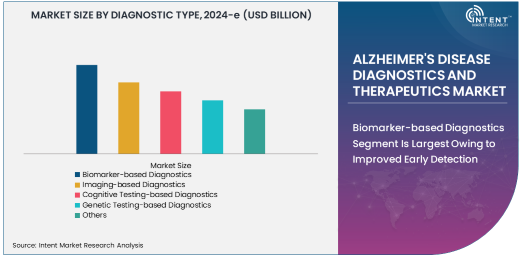
Biomarker-based Diagnostics Segment Is Largest Owing to Improved Early Detection
Biomarker-based diagnostics play a significant role in the Alzheimer's disease market, being the largest subsegment due to their capability to detect disease biomarkers such as amyloid plaques, tau proteins, and neurodegeneration. These biomarkers are crucial for diagnosing Alzheimer’s at early stages, which is essential for better management and treatment outcomes. With advancements in blood tests and cerebrospinal fluid analyses, biomarker-based diagnostics have become a vital tool for clinicians, enabling them to diagnose Alzheimer’s with higher accuracy and reliability. This has led to a growing demand for such diagnostic solutions, particularly in regions with an aging population.
The development of more refined and non-invasive biomarker testing methods, such as blood-based diagnostic tests, is further expanding the scope of this segment. As clinical trials focus on identifying new biomarkers and improving diagnostic algorithms, the role of biomarkers in Alzheimer's diagnosis is expected to continue to grow, positioning this subsegment at the forefront of the market.
Drug-based Therapies Segment Is Largest Owing to Market Dominance
Drug-based therapies are the largest subsegment in the therapeutic treatment of Alzheimer's disease, accounting for the largest share of the market. This is due to the significant number of FDA-approved drugs such as cholinesterase inhibitors and glutamate regulators, which are used to treat symptoms of Alzheimer's. Drug therapies are the most common treatment option prescribed to patients, with a strong focus on slowing cognitive decline and managing symptoms, even though they are not curative. Major pharmaceutical companies are increasingly investing in research to develop disease-modifying therapies that target the underlying causes of Alzheimer's, such as amyloid plaques and tau proteins.
This subsegment is expected to remain dominant as new drug candidates, including monoclonal antibodies like Aducanumab and Donanemab, are emerging, showing promise in altering the course of the disease. As a result, drug-based therapies continue to lead the market, and ongoing clinical trials for new treatments are expected to further boost the segment's growth.
Hospitals Segment Is Largest Owing to High Treatment Demand
Hospitals are the largest end-user segment in the Alzheimer's diagnostics and therapeutics market, driven by the high demand for specialized care and diagnostic services. Hospitals offer both inpatient and outpatient care, including advanced diagnostic testing, treatment administration, and long-term care for Alzheimer's patients. These facilities are equipped with the latest technologies in imaging, cognitive testing, and biomarker-based diagnostics, making them the preferred choice for patients requiring comprehensive care. Furthermore, hospitals are often the first point of contact for patients diagnosed with Alzheimer's, where they receive the necessary medical evaluations, medication prescriptions, and therapeutic interventions.
The role of hospitals is critical as they provide specialized care, including multidisciplinary teams of neurologists, geriatricians, and psychologists. As the demand for Alzheimer’s care increases, hospitals are expected to see continued growth in their involvement in both diagnostic and therapeutic services.
Direct Sales Segment Is Fastest Growing Owing to Personalized Approaches
The direct sales distribution channel is the fastest growing in the Alzheimer's diagnostics and therapeutics market. This growth is primarily driven by the increasing demand for personalized diagnostic tools and therapies that require direct consultation between healthcare providers and patients. Direct sales allow pharmaceutical and diagnostic companies to offer customized solutions, such as personalized treatment plans and at-home diagnostic kits, which are particularly valuable in Alzheimer's care. In addition, direct sales facilitate better patient education and adherence to prescribed therapies, contributing to improved therapeutic outcomes.
Furthermore, the rise of telemedicine and home care services is increasing the demand for direct sales, allowing patients to access treatments and diagnostic products without needing to visit healthcare facilities. As the market continues to shift toward more personalized care options, the direct sales channel is expected to experience the most rapid growth in the coming years.
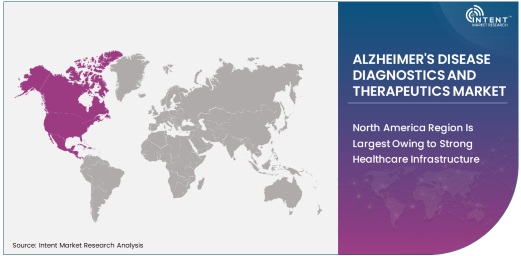
North America Region Is Largest Owing to Strong Healthcare Infrastructure
North America is the largest region in the Alzheimer's disease diagnostics and therapeutics market, accounting for the largest share of the global market. The region’s dominance is attributed to its advanced healthcare infrastructure, high awareness of Alzheimer’s, and the growing aging population. The United States, in particular, is the primary driver of this growth, with a significant number of Alzheimer’s patients and ongoing investments in research and development. The availability of state-of-the-art diagnostic tools and therapeutic treatments in North America makes it the leading region for both diagnostics and therapeutics.
Government initiatives such as the National Institute on Aging's Alzheimer's Disease Program and private investments in R&D are further accelerating market growth in North America. The region's high healthcare expenditure and focus on improving patient care for Alzheimer's also bolster its position as the largest market for Alzheimer's diagnostics and therapeutics.
Leading Companies and Competitive Landscape
The Alzheimer's disease diagnostics and therapeutics market is highly competitive, with major pharmaceutical and diagnostic companies leading the charge. Eli Lilly, Biogen, Roche, and Novartis are among the top players in drug-based therapies, with several innovative treatments either already approved or in the pipeline. In diagnostics, Siemens Healthineers, GE Healthcare, and AbbVie are key players, providing cutting-edge imaging and biomarker-based diagnostic solutions.
These companies are increasingly focusing on partnerships, mergers, and acquisitions to expand their portfolios and boost their market share. For instance, Biogen's collaboration with Eisai on the development of Alzheimer's treatments has been pivotal in advancing new therapeutics. As the market continues to evolve, competition is expected to intensify with more companies entering the space, particularly in gene therapies and personalized medicine for Alzheimer's, aiming to provide more effective disease-modifying treatments and improve patient outcomes.
Recent Developments:
- Eli Lilly and Company received FDA approval for Donanemab, a monoclonal antibody aimed at reducing amyloid plaques, marking a significant advancement in Alzheimer's treatment.
- Biogen Inc. and Eisai Co., Ltd. announced a partnership for the development of Leqembi, an anti-amyloid treatment recently approved by the FDA for early Alzheimer’s stages.
- Roche Diagnostics launched Elecsys® Amyloid Beta 42/40 Ratio, a new blood test that detects biomarkers associated with Alzheimer’s, for early-stage diagnosis.
- AstraZeneca entered into an exclusive partnership with Ionis Pharmaceuticals to develop a new RNA-targeted therapeutic for Alzheimer's disease, aiming to improve disease-modifying treatments.
- Amgen Inc. received FDA orphan drug designation for Amyloid-Targeted Monoclonal Antibody, a treatment aiming to reduce amyloid plaques and slow disease progression in Alzheimer’s patients.
List of Leading Companies:
- Eli Lilly and Company
- Biogen Inc.
- Roche Diagnostics
- Novartis
- AstraZeneca
- Merck & Co.
- Johnson & Johnson
- Pfizer Inc.
- AbbVie Inc.
- Amgen Inc.
- Sanofi
- Takeda Pharmaceutical Company
- H. Lundbeck A/S
- GlaxoSmithKline
- Otsuka Pharmaceutical Co., Ltd.
Report Scope:
|
Report Features |
Description |
|
Market Size (2024-e) |
USD 7.5 Billion |
|
Forecasted Value (2030) |
USD 10.3 Billion |
|
CAGR (2025 – 2030) |
5.4% |
|
Base Year for Estimation |
2024-e |
|
Historic Year |
2023 |
|
Forecast Period |
2025 – 2030 |
|
Report Coverage |
Market Forecast, Market Dynamics, Competitive Landscape, Recent Developments |
|
Segments Covered |
Alzheimer's Disease Diagnostics and Therapeutics Market By Diagnostic Type (Biomarker-based Diagnostics, Imaging-based Diagnostics, Cognitive Testing-based Diagnostics, Genetic Testing-based Diagnostics), By Therapeutic Type (Drug-based Therapies, Non-drug-based Therapies, Gene Therapy, Immunotherapies), By End-User (Hospitals, Diagnostic Centers, Research Institutes, Home Care Settings, Ambulatory Surgical Centers) |
|
Regional Analysis |
North America (US, Canada, Mexico), Europe (Germany, France, UK, Italy, Spain, and Rest of Europe), Asia-Pacific (China, Japan, South Korea, Australia, India, and Rest of Asia-Pacific), Latin America (Brazil, Argentina, and Rest of Latin America), Middle East & Africa (Saudi Arabia, UAE, Rest of Middle East & Africa) |
|
Major Companies |
Eli Lilly and Company, Biogen Inc., Roche Diagnostics, Novartis, AstraZeneca, Merck & Co., Johnson & Johnson, Pfizer Inc., AbbVie Inc., Amgen Inc., Sanofi, Takeda Pharmaceutical Company, H. Lundbeck A/S, GlaxoSmithKline, Otsuka Pharmaceutical Co., Ltd. |
|
Customization Scope |
Customization for segments, region/country-level will be provided. Moreover, additional customization can be done based on the requirements |
|
1. Introduction |
|
1.1. Market Definition |
|
1.2. Scope of the Study |
|
1.3. Research Assumptions |
|
1.4. Study Limitations |
|
2. Research Methodology |
|
2.1. Research Approach |
|
2.1.1. Top-Down Method |
|
2.1.2. Bottom-Up Method |
|
2.1.3. Factor Impact Analysis |
|
2.2. Insights & Data Collection Process |
|
2.2.1. Secondary Research |
|
2.2.2. Primary Research |
|
2.3. Data Mining Process |
|
2.3.1. Data Analysis |
|
2.3.2. Data Validation and Revalidation |
|
2.3.3. Data Triangulation |
|
3. Executive Summary |
|
3.1. Major Markets & Segments |
|
3.2. Highest Growing Regions and Respective Countries |
|
3.3. Impact of Growth Drivers & Inhibitors |
|
3.4. Regulatory Overview by Country |
|
4. Alzheimer's Disease Diagnostics and Therapeutics Market, by Diagnostic Type (Market Size & Forecast: USD Million, 2023 – 2030) |
|
4.1. Biomarker-based Diagnostics |
|
4.2. Imaging-based Diagnostics |
|
4.3. Cognitive Testing-based Diagnostics |
|
4.4. Genetic Testing-based Diagnostics |
|
4.5. Others |
|
5. Alzheimer's Disease Diagnostics and Therapeutics Market, by Therapeutic Type (Market Size & Forecast: USD Million, 2023 – 2030) |
|
5.1. Drug-based Therapies |
|
5.2. Non-drug-based Therapies |
|
5.3. Gene Therapy |
|
5.4. Immunotherapies |
|
5.5. Others |
|
6. Alzheimer's Disease Diagnostics and Therapeutics Market, by End-User (Market Size & Forecast: USD Million, 2023 – 2030) |
|
6.1. Hospitals |
|
6.2. Diagnostic Centers |
|
6.3. Research Institutes |
|
6.4. Home Care Settings |
|
6.5. Ambulatory Surgical Centers |
|
7. Alzheimer's Disease Diagnostics and Therapeutics Market, by Distribution Channel (Market Size & Forecast: USD Million, 2023 – 2030) |
|
7.1. Direct Sales |
|
7.2. Online Sales |
|
7.3. Third-party Distributors |
|
8. Regional Analysis (Market Size & Forecast: USD Million, 2023 – 2030) |
|
8.1. Regional Overview |
|
8.2. North America |
|
8.2.1. Regional Trends & Growth Drivers |
|
8.2.2. Barriers & Challenges |
|
8.2.3. Opportunities |
|
8.2.4. Factor Impact Analysis |
|
8.2.5. Technology Trends |
|
8.2.6. North America Alzheimer's Disease Diagnostics and Therapeutics Market, by Diagnostic Type |
|
8.2.7. North America Alzheimer's Disease Diagnostics and Therapeutics Market, by Therapeutic Type |
|
8.2.8. North America Alzheimer's Disease Diagnostics and Therapeutics Market, by End-User |
|
8.2.9. North America Alzheimer's Disease Diagnostics and Therapeutics Market, by Distribution Channel |
|
8.2.10. By Country |
|
8.2.10.1. US |
|
8.2.10.1.1. US Alzheimer's Disease Diagnostics and Therapeutics Market, by Diagnostic Type |
|
8.2.10.1.2. US Alzheimer's Disease Diagnostics and Therapeutics Market, by Therapeutic Type |
|
8.2.10.1.3. US Alzheimer's Disease Diagnostics and Therapeutics Market, by End-User |
|
8.2.10.1.4. US Alzheimer's Disease Diagnostics and Therapeutics Market, by Distribution Channel |
|
8.2.10.2. Canada |
|
8.2.10.3. Mexico |
|
*Similar segmentation will be provided for each region and country |
|
8.3. Europe |
|
8.4. Asia-Pacific |
|
8.5. Latin America |
|
8.6. Middle East & Africa |
|
9. Competitive Landscape |
|
9.1. Overview of the Key Players |
|
9.2. Competitive Ecosystem |
|
9.2.1. Level of Fragmentation |
|
9.2.2. Market Consolidation |
|
9.2.3. Product Innovation |
|
9.3. Company Share Analysis |
|
9.4. Company Benchmarking Matrix |
|
9.4.1. Strategic Overview |
|
9.4.2. Product Innovations |
|
9.5. Start-up Ecosystem |
|
9.6. Strategic Competitive Insights/ Customer Imperatives |
|
9.7. ESG Matrix/ Sustainability Matrix |
|
9.8. Manufacturing Network |
|
9.8.1. Locations |
|
9.8.2. Supply Chain and Logistics |
|
9.8.3. Product Flexibility/Customization |
|
9.8.4. Digital Transformation and Connectivity |
|
9.8.5. Environmental and Regulatory Compliance |
|
9.9. Technology Readiness Level Matrix |
|
9.10. Technology Maturity Curve |
|
9.11. Buying Criteria |
|
10. Company Profiles |
|
10.1. Eli Lilly and Company |
|
10.1.1. Company Overview |
|
10.1.2. Company Financials |
|
10.1.3. Product/Service Portfolio |
|
10.1.4. Recent Developments |
|
10.1.5. IMR Analysis |
|
*Similar information will be provided for other companies |
|
10.2. Biogen Inc. |
|
10.3. Roche Diagnostics |
|
10.4. Novartis |
|
10.5. AstraZeneca |
|
10.6. Merck & Co. |
|
10.7. Johnson & Johnson |
|
10.8. Pfizer Inc. |
|
10.9. AbbVie Inc. |
|
10.10. Amgen Inc. |
|
10.11. Sanofi |
|
10.12. Takeda Pharmaceutical Company |
|
10.13. H. Lundbeck A/S |
|
10.14. GlaxoSmithKline |
|
10.15. Otsuka Pharmaceutical Co., Ltd. |
|
11. Appendix |
A comprehensive market research approach was employed to gather and analyze data on the Alzheimer's Disease Diagnostics and Therapeutics Market. In the process, the analysis was also done to analyze the parent market and relevant adjacencies to measure the impact of them on the Alzheimer's Disease Diagnostics and Therapeutics Market. The research methodology encompassed both secondary and primary research techniques, ensuring the accuracy and credibility of the findings.
.jpg)
Secondary Research
Secondary research involved a thorough review of pertinent industry reports, journals, articles, and publications. Additionally, annual reports, press releases, and investor presentations of industry players were scrutinized to gain insights into their market positioning and strategies.
Primary Research
Primary research involved conducting in-depth interviews with industry experts, stakeholders, and market participants across the E-Waste Management ecosystem. The primary research objectives included:
- Validating findings and assumptions derived from secondary research
- Gathering qualitative and quantitative data on market trends, drivers, and challenges
- Understanding the demand-side dynamics, encompassing end-users, component manufacturers, facility providers, and service providers
- Assessing the supply-side landscape, including technological advancements and recent developments
Market Size Assessment
A combination of top-down and bottom-up approaches was utilized to analyze the overall size of the Alzheimer's Disease Diagnostics and Therapeutics Market. These methods were also employed to assess the size of various subsegments within the market. The market size assessment methodology encompassed the following steps:
- Identification of key industry players and relevant revenues through extensive secondary research
- Determination of the industry's supply chain and market size, in terms of value, through primary and secondary research processes
- Calculation of percentage shares, splits, and breakdowns using secondary sources and verification through primary sources
.jpg)
Data Triangulation
To ensure the accuracy and reliability of the market size, data triangulation was implemented. This involved cross-referencing data from various sources, including demand and supply side factors, market trends, and expert opinions. Additionally, top-down and bottom-up approaches were employed to validate the market size assessment.
NA