
As per Intent Market Research, the Aluminum Laminated Film Market was valued at USD 1.7 Billion in 2024-e and will surpass USD 4.3 Billion by 2030; growing at a CAGR of 16.9% during 2025-2030.
The aluminum laminated film market has experienced significant growth in recent years, driven by its versatility in packaging applications and superior properties like barrier protection, durability, and light-blocking capabilities. This material is increasingly used across various industries, including food packaging, pharmaceuticals, and consumer goods. The rising demand for safe, sustainable, and efficient packaging solutions has been a major factor influencing the growth of this market. As manufacturers and consumers alike seek packaging that improves product shelf life and reduces environmental impact, aluminum laminated films are becoming an essential component of modern packaging solutions.
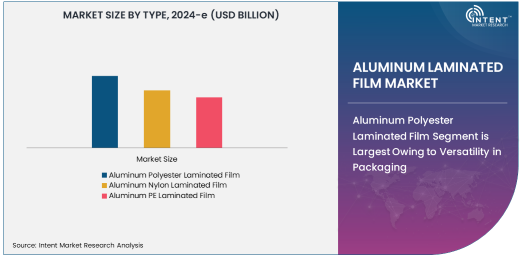
Aluminum Polyester Laminated Film Segment is Largest Owing to Versatility in Packaging
Among the various types of aluminum laminated films, Aluminum Polyester Laminated Film holds the largest market share. This segment is favored for its excellent barrier properties and adaptability across multiple industries. Aluminum polyester laminated films combine the strength of polyester with the protective qualities of aluminum foil, providing superior resistance to moisture, light, and oxygen. As a result, it is widely used in food packaging, pharmaceuticals, and consumer goods packaging, where product preservation is essential. The ability to form flexible, durable, and high-performance packaging solutions has made aluminum polyester laminated films the go-to choice for manufacturers across the globe.
The growth of the Aluminum Polyester Laminated Film segment is largely driven by the increase in demand for packaged food and beverages, particularly in emerging markets where convenience and product safety are paramount. As consumers become more focused on the integrity and longevity of packaged goods, aluminum polyester laminated films offer a reliable solution. Furthermore, the pharmaceutical industry's need for tamper-proof, airtight packaging has contributed to the segment's dominance in the market.
Food & Beverage Packaging Segment is Fastest Growing Owing to Rising Demand for Convenience and Shelf Life
In terms of application, Food & Beverage Packaging is the fastest-growing segment in the aluminum laminated film market. This growth can be attributed to the increasing demand for packaged food products, as well as the need for packaging materials that extend shelf life and maintain product freshness. The food and beverage industry is particularly sensitive to factors such as moisture, light, and air, which can affect product quality and safety. Aluminum laminated films provide an effective barrier to these elements, making them ideal for food packaging.
As the global demand for ready-to-eat meals, frozen foods, and beverages continues to rise, manufacturers are increasingly adopting aluminum laminated films for packaging. With consumer preferences shifting toward convenience, longer shelf life, and sustainability, food manufacturers are turning to aluminum laminated films as an optimal solution. The growing trend toward eco-friendly and recyclable packaging further supports the demand for aluminum laminated films in this segment, making it the fastest-growing within the overall market.
Food & Beverages End-Use Industry is Largest Owing to Demand for Safe and Long-Lasting Packaging
The Food & Beverages end-use industry holds the largest share in the aluminum laminated film market. The sector's massive scale, driven by global demand for packaged food and beverage products, continues to fuel the growth of aluminum laminated films. Aluminum films offer superior protection to food items, which is especially important as consumers demand longer-lasting, high-quality products. Additionally, with an increasing focus on sustainability, the food industry is seeking packaging solutions that are both effective and environmentally friendly.
As the food and beverage sector continues to grow, particularly in emerging economies, the demand for aluminum laminated films is expected to rise correspondingly. The versatility of this packaging solution makes it ideal for a variety of food products, including snacks, frozen foods, and beverages. Furthermore, the increasing emphasis on food safety regulations and the need for packaging that ensures product integrity are further driving the adoption of aluminum laminated films in the food and beverages industry.
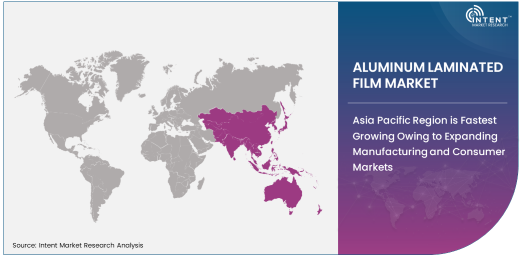
Asia Pacific Region is Fastest Growing Owing to Expanding Manufacturing and Consumer Markets
Asia Pacific is the fastest-growing region in the aluminum laminated film market. The rapid industrialization, urbanization, and expanding middle-class population in countries such as China, India, and Southeast Asia are significant contributors to the market's growth in this region. As consumer demand for packaged goods rises, the need for efficient, long-lasting packaging solutions becomes more pronounced. In particular, the food and beverage industry in Asia Pacific is experiencing a boom, further driving the demand for aluminum laminated films.
The region’s growing manufacturing capabilities, particularly in the food, pharmaceutical, and consumer goods sectors, are also playing a key role in expanding the demand for aluminum laminated films. As manufacturers increasingly focus on developing cost-effective yet high-quality packaging solutions, the aluminum laminated film market in Asia Pacific is poised for rapid expansion in the coming years. Additionally, the region’s shift toward sustainability and eco-friendly packaging solutions will likely continue to propel market growth.
Leading Companies and Competitive Landscape
The aluminum laminated film market is highly competitive, with several key players dominating the global landscape. Companies such as Amcor Limited, Mondi Group, Sealed Air Corporation, and Berry Global Inc. are leading the market with their extensive product portfolios and innovative packaging solutions. These companies focus on continuous innovation, adopting sustainable practices, and expanding their production capabilities to meet the growing demand for aluminum laminated films.
The competitive landscape is marked by increasing mergers and acquisitions (M&A) as companies seek to expand their market presence and enhance their product offerings. Additionally, market players are investing heavily in research and development (R&D) to develop more efficient, cost-effective, and sustainable packaging solutions. With the increasing focus on environmental sustainability and the demand for high-performance packaging, companies in the aluminum laminated film market are likely to continue innovating to maintain their competitive edge.
Recent Developments:
- Amcor introduced new eco-friendly aluminum laminated film solutions designed to reduce carbon footprints and improve recyclability for the food and beverage industry.
- Uflex expanded its aluminum laminated film production capacity to meet the rising demand for packaging solutions in the pharmaceutical and food industries.
- Mondi completed the acquisition of a flexible packaging company specializing in aluminum laminated films, enhancing its portfolio for sustainable and barrier packaging solutions.
- Berry Global announced the launch of a new sustainable aluminum laminated film product line aimed at reducing plastic waste in food packaging.
- Sealed Air entered a strategic partnership with a leading pharmaceutical company to develop high-performance aluminum laminated films for sensitive medicines and medical devices.
List of Leading Companies:
- Amcor Limited
- Constantia Flexibles
- Mondi Group
- Sealed Air Corporation
- Berry Global Inc.
- Huhtamaki Group
- Uflex Limited
- Jindal Poly Films Limited
- Toray Industries, Inc.
- Sonoco Products Company
- Kraton Polymers
- DuPont de Nemours, Inc.
- Wipak Group
- Futamura Chemical Company Ltd.
- Polyplex Corporation Limited
Report Scope:
|
Report Features |
Description |
|
Market Size (2024-e) |
USD 1.7 Billion |
|
Forecasted Value (2030) |
USD 4.3 Billion |
|
CAGR (2025 – 2030) |
16.9% |
|
Base Year for Estimation |
2024-e |
|
Historic Year |
2023 |
|
Forecast Period |
2025 – 2030 |
|
Report Coverage |
Market Forecast, Market Dynamics, Competitive Landscape, Recent Developments |
|
Segments Covered |
Aluminum Laminated Film Market By Product Type (Aluminum Polyester Laminated Film, Aluminum Nylon Laminated Film, Aluminum PE Laminated Film), By Application (Packaging, Food & Beverage Packaging, Pharmaceutical Packaging, Cosmetics & Personal Care Packaging, Industrial Packaging), By End-Use Industry (Food & Beverages, Pharmaceuticals, Cosmetics & Personal Care, Automotive & Transportation, Electronics) |
|
Regional Analysis |
North America (US, Canada, Mexico), Europe (Germany, France, UK, Italy, Spain, and Rest of Europe), Asia-Pacific (China, Japan, South Korea, Australia, India, and Rest of Asia-Pacific), Latin America (Brazil, Argentina, and Rest of Latin America), Middle East & Africa (Saudi Arabia, UAE, Rest of Middle East & Africa) |
|
Major Companies |
Amcor Limited, Constantia Flexibles, Mondi Group, Sealed Air Corporation, Berry Global Inc., Huhtamaki Group, Uflex Limited, Jindal Poly Films Limited, Toray Industries, Inc., Sonoco Products Company, Kraton Polymers, DuPont de Nemours, Inc., Wipak Group, Futamura Chemical Company Ltd., Polyplex Corporation Limited |
|
Customization Scope |
Customization for segments, region/country-level will be provided. Moreover, additional customization can be done based on the requirements |
|
1. Introduction |
|
1.1. Market Definition |
|
1.2. Scope of the Study |
|
1.3. Research Assumptions |
|
1.4. Study Limitations |
|
2. Research Methodology |
|
2.1. Research Approach |
|
2.1.1. Top-Down Method |
|
2.1.2. Bottom-Up Method |
|
2.1.3. Factor Impact Analysis |
|
2.2. Insights & Data Collection Process |
|
2.2.1. Secondary Research |
|
2.2.2. Primary Research |
|
2.3. Data Mining Process |
|
2.3.1. Data Analysis |
|
2.3.2. Data Validation and Revalidation |
|
2.3.3. Data Triangulation |
|
3. Executive Summary |
|
3.1. Major Markets & Segments |
|
3.2. Highest Growing Regions and Respective Countries |
|
3.3. Impact of Growth Drivers & Inhibitors |
|
3.4. Regulatory Overview by Country |
|
4. Aluminum Laminated Film Market, by Type (Market Size & Forecast: USD Million, 2023 – 2030) |
|
4.1. Aluminum Polyester Laminated Film |
|
4.2. Aluminum Nylon Laminated Film |
|
4.3. Aluminum PE Laminated Film |
|
5. Aluminum Laminated Film Market, by Application (Market Size & Forecast: USD Million, 2023 – 2030) |
|
5.1. Packaging |
|
5.2. Food & Beverage Packaging |
|
5.3. Pharmaceutical Packaging |
|
5.4. Cosmetics & Personal Care Packaging |
|
5.5. Industrial Packaging |
|
6. Aluminum Laminated Film Market, by End-Use Industry (Market Size & Forecast: USD Million, 2023 – 2030) |
|
6.1. Food & Beverages |
|
6.2. Pharmaceuticals |
|
6.3. Cosmetics & Personal Care |
|
6.4. Automotive & Transportation |
|
6.5. Electronics |
|
7. Regional Analysis (Market Size & Forecast: USD Million, 2023 – 2030) |
|
7.1. Regional Overview |
|
7.2. North America |
|
7.2.1. Regional Trends & Growth Drivers |
|
7.2.2. Barriers & Challenges |
|
7.2.3. Opportunities |
|
7.2.4. Factor Impact Analysis |
|
7.2.5. Technology Trends |
|
7.2.6. North America Aluminum Laminated Film Market, by Type |
|
7.2.7. North America Aluminum Laminated Film Market, by Application |
|
7.2.8. North America Aluminum Laminated Film Market, by End-Use Industry |
|
7.2.9. By Country |
|
7.2.9.1. US |
|
7.2.9.1.1. US Aluminum Laminated Film Market, by Type |
|
7.2.9.1.2. US Aluminum Laminated Film Market, by Application |
|
7.2.9.1.3. US Aluminum Laminated Film Market, by End-Use Industry |
|
7.2.9.2. Canada |
|
7.2.9.3. Mexico |
|
*Similar segmentation will be provided for each region and country |
|
7.3. Europe |
|
7.4. Asia-Pacific |
|
7.5. Latin America |
|
7.6. Middle East & Africa |
|
8. Competitive Landscape |
|
8.1. Overview of the Key Players |
|
8.2. Competitive Ecosystem |
|
8.2.1. Level of Fragmentation |
|
8.2.2. Market Consolidation |
|
8.2.3. Product Innovation |
|
8.3. Company Share Analysis |
|
8.4. Company Benchmarking Matrix |
|
8.4.1. Strategic Overview |
|
8.4.2. Product Innovations |
|
8.5. Start-up Ecosystem |
|
8.6. Strategic Competitive Insights/ Customer Imperatives |
|
8.7. ESG Matrix/ Sustainability Matrix |
|
8.8. Manufacturing Network |
|
8.8.1. Locations |
|
8.8.2. Supply Chain and Logistics |
|
8.8.3. Product Flexibility/Customization |
|
8.8.4. Digital Transformation and Connectivity |
|
8.8.5. Environmental and Regulatory Compliance |
|
8.9. Technology Readiness Level Matrix |
|
8.10. Technology Maturity Curve |
|
8.11. Buying Criteria |
|
9. Company Profiles |
|
9.1. Amcor Limited |
|
9.1.1. Company Overview |
|
9.1.2. Company Financials |
|
9.1.3. Product/Service Portfolio |
|
9.1.4. Recent Developments |
|
9.1.5. IMR Analysis |
|
*Similar information will be provided for other companies |
|
9.2. Constantia Flexibles |
|
9.3. Mondi Group |
|
9.4. Sealed Air Corporation |
|
9.5. Berry Global Inc. |
|
9.6. Huhtamaki Group |
|
9.7. Uflex Limited |
|
9.8. Jindal Poly Films Limited |
|
9.9. Toray Industries, Inc. |
|
9.10. Sonoco Products Company |
|
9.11. Kraton Polymers |
|
9.12. DuPont de Nemours, Inc. |
|
9.13. Wipak Group |
|
9.14. Futamura Chemical Company Ltd. |
|
9.15. Polyplex Corporation Limited |
|
10. Appendix |
A comprehensive market research approach was employed to gather and analyze data on the Aluminum Laminated Film Market. In the process, the analysis was also done to analyze the parent market and relevant adjacencies to measure the impact of them on the Aluminum Laminated Film Market. The research methodology encompassed both secondary and primary research techniques, ensuring the accuracy and credibility of the findings.
.jpg)
Secondary Research
Secondary research involved a thorough review of pertinent industry reports, journals, articles, and publications. Additionally, annual reports, press releases, and investor presentations of industry players were scrutinized to gain insights into their market positioning and strategies.
Primary Research
Primary research involved conducting in-depth interviews with industry experts, stakeholders, and market participants across the E-Waste Management ecosystem. The primary research objectives included:
- Validating findings and assumptions derived from secondary research
- Gathering qualitative and quantitative data on market trends, drivers, and challenges
- Understanding the demand-side dynamics, encompassing end-users, component manufacturers, facility providers, and service providers
- Assessing the supply-side landscape, including technological advancements and recent developments
Market Size Assessment
A combination of top-down and bottom-up approaches was utilized to analyze the overall size of the Aluminum Laminated Film Market. These methods were also employed to assess the size of various subsegments within the market. The market size assessment methodology encompassed the following steps:
- Identification of key industry players and relevant revenues through extensive secondary research
- Determination of the industry's supply chain and market size, in terms of value, through primary and secondary research processes
- Calculation of percentage shares, splits, and breakdowns using secondary sources and verification through primary sources
.jpg)
Data Triangulation
To ensure the accuracy and reliability of the market size, data triangulation was implemented. This involved cross-referencing data from various sources, including demand and supply side factors, market trends, and expert opinions. Additionally, top-down and bottom-up approaches were employed to validate the market size assessment.
NA