
As per Intent Market Research, the All Ceramic Dental Crowns Market was valued at USD 2.2 Billion in 2024-e and will surpass USD 4.2 Billion by 2030; growing at a CAGR of 10.9% during 2025-2030.
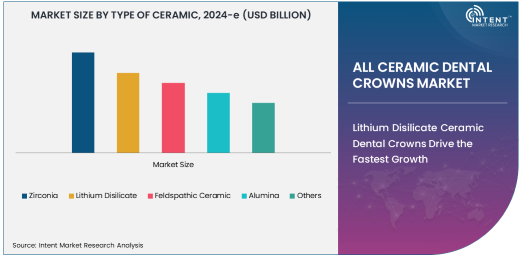
The Zirconia ceramic dental crowns segment dominates the market due to the material's outstanding combination of strength, durability, and aesthetic appeal. Zirconia crowns are highly resistant to fracture and wear, making them suitable for long-term use in dental restorations. The material’s ability to mimic the natural translucency of teeth makes it an attractive option for patients seeking natural-looking results, further driving its widespread adoption in dental procedures. Moreover, advancements in zirconia manufacturing technologies have enabled the creation of crowns that require minimal tooth reduction, providing more comfort and less invasive procedures for patients.
Zirconia’s strong mechanical properties have made it the preferred choice for both posterior and anterior crowns. It is particularly valued for its suitability in high-stress areas of the mouth, such as molars, where strength is crucial. This has made zirconia crowns a staple in both general and cosmetic dentistry, cementing the material's position as the largest segment in the all ceramic dental crowns market.
Lithium Disilicate Ceramic Dental Crowns Drive the Fastest Growth
The lithium disilicate ceramic dental crowns segment is experiencing the fastest growth in the market due to its superior aesthetic qualities and excellent translucency, which closely resemble natural teeth. These crowns are widely used for anterior restorations, as they provide a high level of esthetic results, crucial in visible areas of the mouth. Lithium disilicate crowns are also known for their excellent bond strength and resistance to chipping, which further contributes to their growing popularity.
Advancements in lithium disilicate ceramics have made them increasingly viable for a broader range of applications, including multiple crown restorations. The continuous improvement in manufacturing processes, combined with an increasing focus on aesthetics in dentistry, ensures that lithium disilicate crowns are becoming a go-to option for dental professionals, resulting in their rapid growth in the market. The combination of aesthetic excellence and functional durability positions lithium disilicate as the fastest-growing segment in the all ceramic dental crowns market.
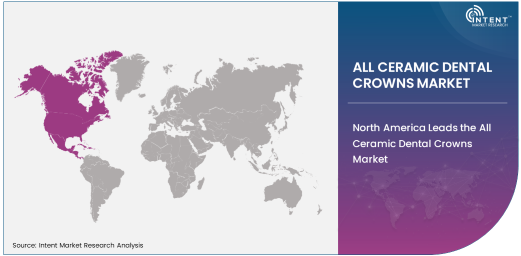
North America Leads the All Ceramic Dental Crowns Market
North America is the largest market for all ceramic dental crowns, driven by the region’s advanced healthcare infrastructure, high disposable income, and increasing demand for cosmetic dental procedures. The U.S. and Canada, in particular, have well-established dental markets where ceramic materials, especially zirconia and lithium disilicate, are preferred for their durability and aesthetic properties. The growing emphasis on dental aesthetics, coupled with technological advancements in digital dentistry, has significantly boosted the adoption of ceramic crowns in restorative dental treatments.
Moreover, the increasing number of dental practitioners adopting CAD/CAM (computer-aided design and computer-aided manufacturing) technologies is enhancing the precision and efficiency of dental crown fabrication, further accelerating the demand for ceramic dental crowns. The focus on enhancing patient comfort and providing long-lasting, aesthetically pleasing results is expected to continue driving the growth of the all ceramic dental crowns market in North America.
Competitive Landscape: Leading Companies and Innovations
The all ceramic dental crowns market is competitive, with key players such as Ivoclar Vivadent, Dentsply Sirona, 3M, VITA Zahnfabrik, and Kuraray Noritake Dental leading the market. These companies focus on continuous innovation to meet the growing demand for high-quality ceramic dental materials that offer both functional and aesthetic benefits. The development of advanced ceramics, such as high-strength zirconia and translucent lithium disilicate, has enabled these companies to expand their product offerings to meet diverse patient needs.
Moreover, strategic partnerships and acquisitions are common as companies look to strengthen their portfolios and expand their reach. The integration of digital dentistry tools, including CAD/CAM systems for precision manufacturing and 3D printing, is reshaping the competitive dynamics of the market, allowing for more customized and accurate dental restorations. As demand for more durable, aesthetically pleasing, and less invasive options increases, leading players are investing in research and development to further innovate and capture a larger share of the all ceramic dental crowns market.
Recent Developments:
- 3M launched a new line of Zirconia-based Ceramic Dental Crowns, designed for improved durability and natural appearance.
- Dentsply Sirona introduced a next-generation lithium disilicate crown with enhanced translucency and strength for better esthetic outcomes.
- Ivoclar Vivadent AG expanded its portfolio with a new feldspathic ceramic crown, offering advanced bonding strength for dental restorations.
- Nobel Biocare Services AG announced a partnership with a major dental laboratory to provide cutting-edge ceramic crown solutions.
- Straumann Group unveiled a new range of all-ceramic crowns featuring improved CAD/CAM integration for faster and more precise dental restorations.
List of Leading Companies:
- 3M
- Nobel Biocare Services AG
- Dentsply Sirona
- Straumann Group
- Ivoclar Vivadent AG
- VITA Zahnfabrik H. Rauter GmbH & Co. KG
- Henry Schein, Inc.
- Shofu Dental Corporation
- GC Corporation
- Mitsui Chemicals, Inc.
- Kuraray Noritake Dental Inc.
- Zubler USA
- Coltene Holding AG
- Dental Wings Inc.
- Argen Corporation
Report Scope:
|
Report Features |
Description |
|
Market Size (2024-e) |
USD 2.2 Billion |
|
Forecasted Value (2030) |
USD 4.2 Billion |
|
CAGR (2025 – 2030) |
10.9% |
|
Base Year for Estimation |
2024-e |
|
Historic Year |
2023 |
|
Forecast Period |
2025 – 2030 |
|
Report Coverage |
Market Forecast, Market Dynamics, Competitive Landscape, Recent Developments |
|
Segments Covered |
All Ceramic Dental Crowns Market By Type of Ceramic (Zirconia, Lithium Disilicate, Feldspathic Ceramic, Alumina), By End-Use Application (Dental Clinics, Dental Laboratories), and By Product Type (Single Crown, Multiple Crown) |
|
Regional Analysis |
North America (US, Canada, Mexico), Europe (Germany, France, UK, Italy, Spain, and Rest of Europe), Asia-Pacific (China, Japan, South Korea, Australia, India, and Rest of Asia-Pacific), Latin America (Brazil, Argentina, and Rest of Latin America), Middle East & Africa (Saudi Arabia, UAE, Rest of Middle East & Africa) |
|
Major Companies |
3M, Nobel Biocare Services AG, Dentsply Sirona, Straumann Group, Ivoclar Vivadent AG, VITA Zahnfabrik H. Rauter GmbH & Co. KG, Henry Schein, Inc., Shofu Dental Corporation, GC Corporation, Mitsui Chemicals, Inc., Kuraray Noritake Dental Inc., Zubler USA, Coltene Holding AG, Dental Wings Inc., Argen Corporation |
|
Customization Scope |
Customization for segments, region/country-level will be provided. Moreover, additional customization can be done based on the requirements |
|
1. Introduction |
|
1.1. Market Definition |
|
1.2. Scope of the Study |
|
1.3. Research Assumptions |
|
1.4. Study Limitations |
|
2. Research Methodology |
|
2.1. Research Approach |
|
2.1.1. Top-Down Method |
|
2.1.2. Bottom-Up Method |
|
2.1.3. Factor Impact Analysis |
|
2.2. Insights & Data Collection Process |
|
2.2.1. Secondary Research |
|
2.2.2. Primary Research |
|
2.3. Data Mining Process |
|
2.3.1. Data Analysis |
|
2.3.2. Data Validation and Revalidation |
|
2.3.3. Data Triangulation |
|
3. Executive Summary |
|
3.1. Major Markets & Segments |
|
3.2. Highest Growing Regions and Respective Countries |
|
3.3. Impact of Growth Drivers & Inhibitors |
|
3.4. Regulatory Overview by Country |
|
4. All Ceramic Dental Crowns Market, by Type of Ceramic (Market Size & Forecast: USD Million, 2023 – 2030) |
|
4.1. Zirconia |
|
4.2. Lithium Disilicate |
|
4.3. Feldspathic Ceramic |
|
4.4. Alumina |
|
4.5. Others |
|
5. All Ceramic Dental Crowns Market, by End-Use Application (Market Size & Forecast: USD Million, 2023 – 2030) |
|
5.1. Dental Clinics |
|
5.2. Dental Laboratories |
|
6. All Ceramic Dental Crowns Market, by Product Type (Market Size & Forecast: USD Million, 2023 – 2030) |
|
6.1. Single Crown |
|
6.2. Multiple Crown |
|
7. Regional Analysis (Market Size & Forecast: USD Million, 2023 – 2030) |
|
7.1. Regional Overview |
|
7.2. North America |
|
7.2.1. Regional Trends & Growth Drivers |
|
7.2.2. Barriers & Challenges |
|
7.2.3. Opportunities |
|
7.2.4. Factor Impact Analysis |
|
7.2.5. Technology Trends |
|
7.2.6. North America All Ceramic Dental Crowns Market, by Type of Ceramic |
|
7.2.7. North America All Ceramic Dental Crowns Market, by End-Use Application |
|
7.2.8. North America All Ceramic Dental Crowns Market, by Product Type |
|
7.2.9. By Country |
|
7.2.9.1. US |
|
7.2.9.1.1. US All Ceramic Dental Crowns Market, by Type of Ceramic |
|
7.2.9.1.2. US All Ceramic Dental Crowns Market, by End-Use Application |
|
7.2.9.1.3. US All Ceramic Dental Crowns Market, by Product Type |
|
7.2.9.2. Canada |
|
7.2.9.3. Mexico |
|
*Similar segmentation will be provided for each region and country |
|
7.3. Europe |
|
7.4. Asia-Pacific |
|
7.5. Latin America |
|
7.6. Middle East & Africa |
|
8. Competitive Landscape |
|
8.1. Overview of the Key Players |
|
8.2. Competitive Ecosystem |
|
8.2.1. Level of Fragmentation |
|
8.2.2. Market Consolidation |
|
8.2.3. Product Innovation |
|
8.3. Company Share Analysis |
|
8.4. Company Benchmarking Matrix |
|
8.4.1. Strategic Overview |
|
8.4.2. Product Innovations |
|
8.5. Start-up Ecosystem |
|
8.6. Strategic Competitive Insights/ Customer Imperatives |
|
8.7. ESG Matrix/ Sustainability Matrix |
|
8.8. Manufacturing Network |
|
8.8.1. Locations |
|
8.8.2. Supply Chain and Logistics |
|
8.8.3. Product Flexibility/Customization |
|
8.8.4. Digital Transformation and Connectivity |
|
8.8.5. Environmental and Regulatory Compliance |
|
8.9. Technology Readiness Level Matrix |
|
8.10. Technology Maturity Curve |
|
8.11. Buying Criteria |
|
9. Company Profiles |
|
9.1. 3M |
|
9.1.1. Company Overview |
|
9.1.2. Company Financials |
|
9.1.3. Product/Service Portfolio |
|
9.1.4. Recent Developments |
|
9.1.5. IMR Analysis |
|
*Similar information will be provided for other companies |
|
9.2. Nobel Biocare Services AG |
|
9.3. Dentsply Sirona |
|
9.4. Straumann Group |
|
9.5. Ivoclar Vivadent AG |
|
9.6. VITA Zahnfabrik H. Rauter GmbH & Co. KG |
|
9.7. Henry Schein, Inc. |
|
9.8. Shofu Dental Corporation |
|
9.9. GC Corporation |
|
9.10. Mitsui Chemicals, Inc. |
|
9.11. Kuraray Noritake Dental Inc. |
|
9.12. Zubler USA |
|
9.13. Coltene Holding AG |
|
9.14. Dental Wings Inc. |
|
9.15. Argen Corporation |
|
10. Appendix |
A comprehensive market research approach was employed to gather and analyze data on the All Ceramic Dental Crowns Market. In the process, the analysis was also done to analyze the parent market and relevant adjacencies to measure the impact of them on the All Ceramic Dental Crowns Market. The research methodology encompassed both secondary and primary research techniques, ensuring the accuracy and credibility of the findings.
.jpg)
Secondary Research
Secondary research involved a thorough review of pertinent industry reports, journals, articles, and publications. Additionally, annual reports, press releases, and investor presentations of industry players were scrutinized to gain insights into their market positioning and strategies.
Primary Research
Primary research involved conducting in-depth interviews with industry experts, stakeholders, and market participants across the E-Waste Management ecosystem. The primary research objectives included:
- Validating findings and assumptions derived from secondary research
- Gathering qualitative and quantitative data on market trends, drivers, and challenges
- Understanding the demand-side dynamics, encompassing end-users, component manufacturers, facility providers, and service providers
- Assessing the supply-side landscape, including technological advancements and recent developments
Market Size Assessment
A combination of top-down and bottom-up approaches was utilized to analyze the overall size of the All Ceramic Dental Crowns Market. These methods were also employed to assess the size of various subsegments within the market. The market size assessment methodology encompassed the following steps:
- Identification of key industry players and relevant revenues through extensive secondary research
- Determination of the industry's supply chain and market size, in terms of value, through primary and secondary research processes
- Calculation of percentage shares, splits, and breakdowns using secondary sources and verification through primary sources
.jpg)
Data Triangulation
To ensure the accuracy and reliability of the market size, data triangulation was implemented. This involved cross-referencing data from various sources, including demand and supply side factors, market trends, and expert opinions. Additionally, top-down and bottom-up approaches were employed to validate the market size assessment.
NA