
As per Intent Market Research, the Air Inject Check Valve Market was valued at USD 1.1 Billion in 2024-e and will surpass USD 2.1 Billion by 2030; growing at a CAGR of 11.2% during 2025-2030.
The air inject check valve market is integral to various industries that require reliable flow control solutions for air and gas systems. These valves prevent the backflow of fluids or gases, ensuring proper system operation and efficiency. The growing demand for optimized performance in automotive, industrial, HVAC, and marine systems has significantly driven the market. The key advantage of air inject check valves lies in their ability to ensure a controlled and steady flow while preventing reverse flow, a critical feature in many fluid systems.
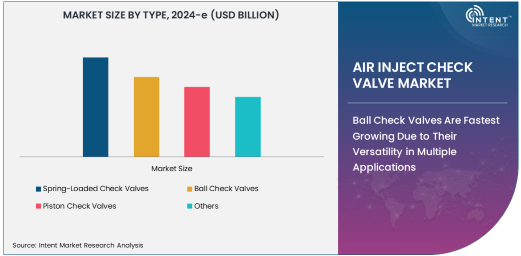
Among the various types, spring-loaded check valves dominate the market. These valves are widely preferred due to their simplicity, durability, and cost-effectiveness. Spring-loaded check valves are commonly used in automotive, industrial, and HVAC applications, where they are essential for maintaining proper airflow and pressure control in engines, compressors, and air conditioning systems. As the demand for efficient, low-maintenance valves in fluid systems continues to grow, spring-loaded check valves remain the largest and most widely used type in the air inject check valve market.
Ball Check Valves Are Fastest Growing Due to Their Versatility in Multiple Applications
Ball check valves are the fastest-growing segment in the air inject check valve market, primarily due to their versatility and ability to function effectively across a wide range of applications. These valves utilize a ball to block reverse flow, providing a more efficient sealing mechanism compared to other valve types. Ball check valves are gaining popularity in industries such as automotive, industrial equipment, and HVAC systems, where their ability to handle various fluid pressures and maintain high flow rates is critical.
The increasing adoption of ball check valves is driven by their ability to perform reliably in both high-pressure and low-pressure applications. The automotive sector, in particular, is leveraging ball check valves in fuel systems, engines, and exhaust systems, where optimal performance and durability are required. With a growing focus on maximizing system efficiency and ensuring minimal downtime, ball check valves are expected to witness rapid growth, making them the fastest-growing segment in the air inject check valve market.
Automotive Sector Leads End-User Industry Segment Due to High Demand for Performance and Efficiency
The automotive industry is the largest end-user segment in the air inject check valve market. The automotive sector's increasing demand for high-performance vehicles with optimized fuel efficiency and reduced emissions is driving the growth of air inject check valves. These valves are crucial in automotive fuel and exhaust systems, helping to regulate airflow, manage fuel injection systems, and control emissions.
As automakers continue to develop more fuel-efficient and environmentally friendly vehicles, the need for reliable air inject check valves in engines and emission control systems has surged. This trend is especially prominent in the growing electric vehicle (EV) market, where air inject check valves are being adapted for use in hybrid and fully electric powertrains. The automotive industry's focus on innovation, performance, and sustainability positions it as the largest end-user segment in the air inject check valve market.
Industrial Equipment Applications Drive Demand for Air Inject Check Valves
Industrial equipment is one of the key application segments for air inject check valves, with significant demand arising from industries such as manufacturing, energy, and power. These valves are essential in maintaining the smooth operation of various industrial systems, including compressors, turbines, and pneumatic equipment. In these applications, air inject check valves ensure that air and gases flow in one direction, preventing system failures caused by backflow and maintaining the efficiency of equipment.
The industrial sector is increasingly relying on air inject check valves to ensure the safety and longevity of machinery. As industries focus on automation, energy efficiency, and reducing downtime, the demand for high-quality valves that can regulate airflow and prevent system failures is expected to grow. This trend is expected to drive further adoption of air inject check valves in industrial equipment applications, making it a critical segment for the market's overall growth.
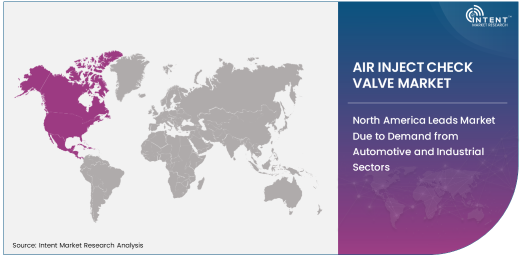
North America Leads Market Due to Demand from Automotive and Industrial Sectors
North America is the largest region in the air inject check valve market, primarily due to the strong presence of the automotive and industrial sectors. The U.S. and Canada are home to major automotive manufacturers and industrial equipment producers, which are significant consumers of air inject check valves. The region's well-established manufacturing base, combined with an increasing focus on high-efficiency systems, has contributed to the demand for these valves across multiple industries.
The automotive industry's robust demand for air inject check valves, especially in engine and exhaust systems, is a key driver of the market in North America. Additionally, the growing industrial automation and power generation sectors are further fueling the demand for these valves. As North American manufacturers continue to innovate and focus on reducing emissions and improving operational efficiency, the air inject check valve market in the region is expected to continue its dominance, supporting global market growth.
Competitive Landscape: Key Players Focus on Innovation and Product Development
The air inject check valve market is highly competitive, with several key players striving to expand their market share through innovation, product development, and strategic partnerships. Companies such as Parker Hannifin Corporation, Emerson Electric Co., and Pentair PLC are leaders in this market, providing a wide range of high-quality check valves designed to meet the needs of industries such as automotive, industrial equipment, HVAC, and marine.
As the demand for efficient fluid systems grows, these companies are focusing on enhancing the durability, performance, and cost-effectiveness of their air inject check valves. Innovations in materials, design, and sealing technologies are expected to drive further growth in the market. Additionally, companies are investing in sustainable manufacturing practices and expanding their product portfolios to meet the evolving needs of end-users. The competitive landscape will continue to be shaped by advancements in valve technology and the ability to offer tailored solutions to meet industry-specific requirements.
Recent Developments:
- Emerson Electric Co. launched an innovative air inject check valve designed for use in high-pressure automotive applications.
- Parker Hannifin Corporation expanded its product line by introducing a new series of ball check valves for industrial fluid systems.
- Flowserve Corporation introduced advanced piston check valves for HVAC systems, providing better flow control and energy efficiency.
- Honeywell International Inc. developed a new range of air inject check valves optimized for aerospace and power generation applications.
- Crane Co. announced the acquisition of a valve manufacturing company to strengthen its position in the global air inject check valve market.
List of Leading Companies:
- Emerson Electric Co.
- Parker Hannifin Corporation
- Honeywell International Inc.
- Flowserve Corporation
- Gates Corporation
- Velan Inc.
- Crane Co.
- IMI PLC
- Alfa Laval
- Mueller Industries, Inc.
- Swagelok Company
- KITZ Corporation
- Rotork PLC
- SMC Corporation
- Schaeffler Technologies AG & Co. KG
Report Scope:
|
Report Features |
Description |
|
Market Size (2024-e) |
USD 1.1 Billion |
|
Forecasted Value (2030) |
USD 2.1 Billion |
|
CAGR (2025 – 2030) |
11.2% |
|
Base Year for Estimation |
2024-e |
|
Historic Year |
2023 |
|
Forecast Period |
2025 – 2030 |
|
Report Coverage |
Market Forecast, Market Dynamics, Competitive Landscape, Recent Developments |
|
Segments Covered |
Air Inject Check Valve Market By Type (Spring-Loaded Check Valves, Ball Check Valves, Piston Check Valves), By Application (Automotive, Industrial Equipment, HVAC Systems, Marine), and By End-User Industry (Automotive Manufacturers, Manufacturing Plants, Aerospace, Energy and Power) |
|
Regional Analysis |
North America (US, Canada, Mexico), Europe (Germany, France, UK, Italy, Spain, and Rest of Europe), Asia-Pacific (China, Japan, South Korea, Australia, India, and Rest of Asia-Pacific), Latin America (Brazil, Argentina, and Rest of Latin America), Middle East & Africa (Saudi Arabia, UAE, Rest of Middle East & Africa) |
|
Major Companies |
Emerson Electric Co., Parker Hannifin Corporation, Honeywell International Inc., Flowserve Corporation, Gates Corporation, Velan Inc., Crane Co., IMI PLC, Alfa Laval, Mueller Industries, Inc., Swagelok Company, KITZ Corporation, Rotork PLC, SMC Corporation, Schaeffler Technologies AG & Co. KG |
|
Customization Scope |
Customization for segments, region/country-level will be provided. Moreover, additional customization can be done based on the requirements |
|
1. Introduction |
|
1.1. Market Definition |
|
1.2. Scope of the Study |
|
1.3. Research Assumptions |
|
1.4. Study Limitations |
|
2. Research Methodology |
|
2.1. Research Approach |
|
2.1.1. Top-Down Method |
|
2.1.2. Bottom-Up Method |
|
2.1.3. Factor Impact Analysis |
|
2.2. Insights & Data Collection Process |
|
2.2.1. Secondary Research |
|
2.2.2. Primary Research |
|
2.3. Data Mining Process |
|
2.3.1. Data Analysis |
|
2.3.2. Data Validation and Revalidation |
|
2.3.3. Data Triangulation |
|
3. Executive Summary |
|
3.1. Major Markets & Segments |
|
3.2. Highest Growing Regions and Respective Countries |
|
3.3. Impact of Growth Drivers & Inhibitors |
|
3.4. Regulatory Overview by Country |
|
4. Air Inject Check Valve Market, by Type (Market Size & Forecast: USD Million, 2023 – 2030) |
|
4.1. Spring-Loaded Check Valves |
|
4.2. Ball Check Valves |
|
4.3. Piston Check Valves |
|
4.4. Others |
|
5. Air Inject Check Valve Market, by Application (Market Size & Forecast: USD Million, 2023 – 2030) |
|
5.1. Automotive |
|
5.2. Industrial Equipment |
|
5.3. HVAC Systems |
|
5.4. Marine |
|
5.5. Others |
|
6. Air Inject Check Valve Market, by End-User Industry (Market Size & Forecast: USD Million, 2023 – 2030) |
|
6.1. Automotive Manufacturers |
|
6.2. Manufacturing Plants |
|
6.3. Aerospace |
|
6.4. Energy and Power |
|
6.5. Others |
|
7. Regional Analysis (Market Size & Forecast: USD Million, 2023 – 2030) |
|
7.1. Regional Overview |
|
7.2. North America |
|
7.2.1. Regional Trends & Growth Drivers |
|
7.2.2. Barriers & Challenges |
|
7.2.3. Opportunities |
|
7.2.4. Factor Impact Analysis |
|
7.2.5. Technology Trends |
|
7.2.6. North America Air Inject Check Valve Market, by Type |
|
7.2.7. North America Air Inject Check Valve Market, by Application |
|
7.2.8. North America Air Inject Check Valve Market, by End-User Industry |
|
7.2.9. By Country |
|
7.2.9.1. US |
|
7.2.9.1.1. US Air Inject Check Valve Market, by Type |
|
7.2.9.1.2. US Air Inject Check Valve Market, by Application |
|
7.2.9.1.3. US Air Inject Check Valve Market, by End-User Industry |
|
7.2.9.2. Canada |
|
7.2.9.3. Mexico |
|
*Similar segmentation will be provided for each region and country |
|
7.3. Europe |
|
7.4. Asia-Pacific |
|
7.5. Latin America |
|
7.6. Middle East & Africa |
|
8. Competitive Landscape |
|
8.1. Overview of the Key Players |
|
8.2. Competitive Ecosystem |
|
8.2.1. Level of Fragmentation |
|
8.2.2. Market Consolidation |
|
8.2.3. Product Innovation |
|
8.3. Company Share Analysis |
|
8.4. Company Benchmarking Matrix |
|
8.4.1. Strategic Overview |
|
8.4.2. Product Innovations |
|
8.5. Start-up Ecosystem |
|
8.6. Strategic Competitive Insights/ Customer Imperatives |
|
8.7. ESG Matrix/ Sustainability Matrix |
|
8.8. Manufacturing Network |
|
8.8.1. Locations |
|
8.8.2. Supply Chain and Logistics |
|
8.8.3. Product Flexibility/Customization |
|
8.8.4. Digital Transformation and Connectivity |
|
8.8.5. Environmental and Regulatory Compliance |
|
8.9. Technology Readiness Level Matrix |
|
8.10. Technology Maturity Curve |
|
8.11. Buying Criteria |
|
9. Company Profiles |
|
9.1. Emerson Electric Co. |
|
9.1.1. Company Overview |
|
9.1.2. Company Financials |
|
9.1.3. Product/Service Portfolio |
|
9.1.4. Recent Developments |
|
9.1.5. IMR Analysis |
|
*Similar information will be provided for other companies |
|
9.2. Parker Hannifin Corporation |
|
9.3. Honeywell International Inc. |
|
9.4. Flowserve Corporation |
|
9.5. Gates Corporation |
|
9.6. Velan Inc. |
|
9.7. Crane Co. |
|
9.8. IMI PLC |
|
9.9. Alfa Laval |
|
9.10. Mueller Industries, Inc. |
|
9.11. Swagelok Company |
|
9.12. KITZ Corporation |
|
9.13. Rotork PLC |
|
9.14. SMC Corporation |
|
9.15. Schaeffler Technologies AG & Co. KG |
|
10. Appendix |
A comprehensive market research approach was employed to gather and analyze data on the Air Inject Check Valve Market. In the process, the analysis was also done to analyze the parent market and relevant adjacencies to measure the impact of them on the Air Inject Check Valve Market. The research methodology encompassed both secondary and primary research techniques, ensuring the accuracy and credibility of the findings.
.jpg)
Secondary Research
Secondary research involved a thorough review of pertinent industry reports, journals, articles, and publications. Additionally, annual reports, press releases, and investor presentations of industry players were scrutinized to gain insights into their market positioning and strategies.
Primary Research
Primary research involved conducting in-depth interviews with industry experts, stakeholders, and market participants across the E-Waste Management ecosystem. The primary research objectives included:
- Validating findings and assumptions derived from secondary research
- Gathering qualitative and quantitative data on market trends, drivers, and challenges
- Understanding the demand-side dynamics, encompassing end-users, component manufacturers, facility providers, and service providers
- Assessing the supply-side landscape, including technological advancements and recent developments
Market Size Assessment
A combination of top-down and bottom-up approaches was utilized to analyze the overall size of the Air Inject Check Valve Market. These methods were also employed to assess the size of various subsegments within the market. The market size assessment methodology encompassed the following steps:
- Identification of key industry players and relevant revenues through extensive secondary research
- Determination of the industry's supply chain and market size, in terms of value, through primary and secondary research processes
- Calculation of percentage shares, splits, and breakdowns using secondary sources and verification through primary sources
.jpg)
Data Triangulation
To ensure the accuracy and reliability of the market size, data triangulation was implemented. This involved cross-referencing data from various sources, including demand and supply side factors, market trends, and expert opinions. Additionally, top-down and bottom-up approaches were employed to validate the market size assessment.
NA